Monday, January 31, 2022

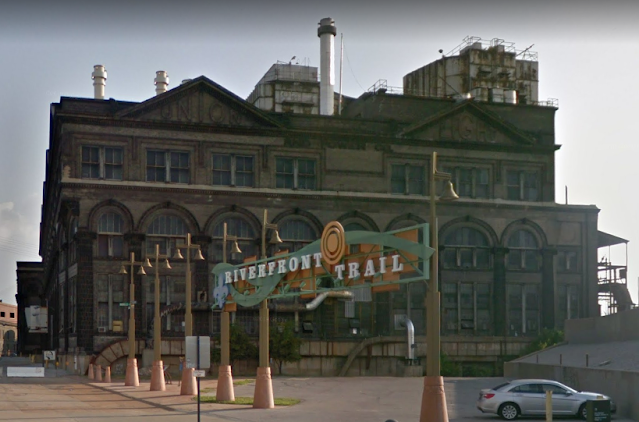
St. Louis, MO: 1904 Ashley Energy/Ameren Missouri Electric Power Plant

(3D Satellite)

Street View

Ashley Energy bought the plant in 2017 and entered a 20-year agreement to "supply reliable green energy to nearly 70 buildings, hotels, sports venues and businesses in the downtown business district." The power plant started in 1904 as a coal-fired power plant. It is now a natural gas-fired cogeneration plant that feeds 17+ miles of stream distribution pipes in downtown St. Louis. [PowerEngineering]
 
Michael Hertter posted
STL. Don't know anything about. But it's a cool building.
Steven Garner: Originally Ashley Plant of Union Electric Co.
Robert Bjordal: I was told that it was built for the 1904 world's fair. I got to tour the plant in the late 1980s. It was supplying district heating steam at about 100 psi in the street. An amazing museum piece. There was a steam powered air compressor with brass and glass drip lubricaters all over it, wide open crosshead mechanism. flyball governor and painted like a circus calliope. The condenser cooling water pipes were riveted steel. It is now Ashley Energy, located on the Mississippi between the Stan Musial and MLK bridges.

Dennis DeBruler commented on Michael's  post
https://www.google.com/.../data=!3m1!1e3!4m5!3m4...

It used to have more and bigger smokestacks.
AshleyEnergy-about

stlouis-mo
The building became a City Landmark in 1971.

In 1998, the plant was providing steam to 135 customers and generating 15mw. This site was to be a new NFL riverfront stadium, but that plan was scrapped when the Rams moved to Los Angeles. [bizjournals]

AshleyEnergy-benefits
"Using the St. Louis district energy system means you have none of the capital costs normally associated with in-building heating systems, including boilers and other associated equipment as well as related insurance, maintenance, upgrade, and replacement costs....The system’s greater efficiency produces fewer greenhouse gas emissions than what is produced by stand-alone systems."

This is the post that motivated researching this power plant. Note that this 2008 image caught some large smokestacks. I presume they were for coal fired boilers that have obviously been retired.
safe_image for Matthew Chapman Flickr
Almost 14 years ago, a coal train from the Hannibal Sub in north St. Louis City traverses the Terminal Railroad Association's High Line along the Mississippi River.
In the background is the beautiful Ashley St. Power Plant. Constructed in 1902 by engineer/architect Charles Ledlic, it was the first large electrical power plant to be erected by the Union Electric Company.
The building became a City Landmark in 1971.
St. Louis, Missouri
August 2008
Dennis DeBruler: You caught the power plant back when it still had some of its large smokestacks.

I'm guessing Tom is referring to this "Ashley."
Tom Heintz posted two photos with the comment: "My dad  began his Union Electric career at Ashley Plant when I was just a little over 4 months old.  A few years ago he have me  these mementos. He retired in 1993 and just celebrated 30 years of retirement 3 days ago.  My sister retired in October of 2021 with almost 41 years from Osage Plant, and I'm going to leave Callaway April 1st with a little over 38 years."
1

2

Rangerricktv posted 11 photos with the comment: "Along the Mississippi River in St. Louis stands the Ashley Street Power House, a massive early-1900s coal plant that once powered the city. Coal arrived by barge, feeding turbines that still sit inside today, frozen in time. With its grand arched windows and “LIGHT” carved into the facade, the building blends history, architecture, and decay. One of the Midwest’s most striking 'abandoned looking' power stations."
Michael Perkins: I know it looks it, but this building is not actually abandoned.
It actually still provides steam heat for a great many buildings in downtown Saint Louis.
This building is the terminus for a series of tunnels that run under the city where utility lines are laid.
When you see steam coming out of the manholes in cold weather, it's coming from this building.
1

2

3

4

5

6

7
Gary Mcclanahan: Worked there in 1973, beautiful building with brass handrails and polished marble

8

9

10

11
Ed Bradley Jr: The last picture in the series is not the Ashley Power Station but rather the Cahokia Power Station which is not generating power anymore.


Bethlehem, PA: Reading Saucon Creek Roundhouse and Coaling Tower

(3D Satellite)

Robert Wanner shared his post of two photos and the comment: "Older and somewhat newer times at Saucon Creek Reading Company facility (on the Bethlehem Branch) with lineup of idle RDC cars, concrete coal dock, roundhouse and turntable showing. Newer photo shows facility in abandonment. The turntable now sits at the Reading Company Technical & Historical Society facility in Hamburg, Pa. Photos by Forrest W. Trittenbach."
1

2

Dennis DeBruler commented on Robert's share
The concrete company uses the roundhouse, but the coaling tower has been torn down.

Dennis DeBruler commented on Robert's share
1964 Nazareth and 1965 Hellerton Quadrangles @ 1:24,000

Google Earth, Apr 1999

Sunday, January 30, 2022

Chicago, IL: 1958 Inland Steel Headquarters, Chicago's First Fully Air Conditioned Building

(3D Satellite)

Unlike the Sears, Hancock and IBM buildings, this building has retained the name of the corporation that built it.

Screenshot @ 0:04

3D Satellite

This was the first office building to be fully air conditioned. Because the air conditioning allowed them to use office space in the middle of the building, they showcased the strength of steel by putting the columns only along the sides and using 60' girders to provide clear span office space. "Each level boasts 177 feet by 58 feet of unobstructed, usable space....When completed in 1958, Inland Steel was the first building constructed in Chicago's Loop in more than 20 years. Its sleek sophisticated design ushered in a new era of modernity in the city. The primarily glass façade is completely devoid of ornamentation. This must have been a surprising change for Chicagoans accustomed to the richly ornamented terra cotta, brick and stone facades of the past." [ArchJourney]
Screenshot @ 1:07

Elevators, restrooms, utilities, etc. were put in an adjacent windowless tower. The service tower is sheathed in stainless steel. [InlandSteelBuilding] "The exterior columns of the building were clad with brushed stainless steel cladding. The irony was that Inland Steel were only producing carbon steel at the time of construction so the stainless steel for the building had to be purchased from another steel company." [DoubleStoneSteel]
Sceeenshot @ 1:22

sah-archipedia, higher resolution is available on the web page
"By the 1950s, Chicagoland had overtaken Pittsburgh as the nation’s steel manufacturing center, but Inland was the only company actually located in the city....As many historians have noted, this was the earliest example of architect Ludwig Mies van der Rohe’s theory of universal space employed for a multistory office building, making Inland Steel the first in a long line of glass-and-steel, unobstructed-open-plan towers. In its form, structure, and style, this typology would dominate American commercial architecture for the next two decades."
 
Mike Joyce comment on a post
I'll never forget going as a teenager downtown in 1960, I was stunned when looking up as I emerged from the subway on the Inland Steel bldg.'s Dearborn St. side A gleaming stainless steel skyscraper soared, and loomed, above me. So amazing I will never forget it. This photo doesn't do it justice.

"At its peak of production in 1978, the company produced 8.6 million tons." [DoubleStoneSteel has a history of Inland Steel]

The sculpture that is in the lobby.
SOM
Richard Lippold’s Radiant One sculpture


THE INLAND STEEL BUILDING: A COLLECTION OF CHICAGO FIRSTS

  • First fully air-conditioned building
  • First indoor, underground parking facility
  • First to use two-inch thick, dual-glazed glass to help with climate control
  • First building constructed on steel pilings
  • First building with automated window washing and mail distribution systems

Saturday, January 29, 2022

Johnstown, PA: 1911 Liberty Wire/Johnstown Wire Technologies/Bethlehem Wire Division

(Satellite)

Johnstown had several mills. As I come across details of what was where, I'm writing notes for each mill.

This plant was built in 1911 after the 1889 Johnstown Flood destroyed the Gautier Works. [wikimapia]

Bradly C Jacob posted
Liberty Wire in Johnstown, PA. Previously Johnstown Wire Technologies and previously before that Bethlehem Steel Wire Division.
James Baker: They running yet?
Matthew Karnes: James Baker never stopped. Still running strong as ever.
Andrew Stewart: Use to haul coiled rod from Charter Steel in Saukville, WI in their. Also from Packer Marine Terminal in Philly. That rod came from Kobe Steel in Japan.

The purchase of Johnstown Wire Technologies by Liberty Steel is recent because Google shows this mill as Johnstown Wire Technologies and offers a mill in Pekin, IL, when you search for Liberty Wire.
Satellite

This is another mill in Pennsylvania squeezed between a river and a hill. The mill was served by the Pennsy RR.
1964 Johnstown Quad @ 1:24,000

“LWJ is the largest producer of value added carbon and alloy wire in North America.” [JohnstownWire]

JohnstownWire-history
"The Johnstown Wire Mill started operations in 1911 as part of Cambria Steel’s integrated plant and was acquired in 1923 by Bethlehem Steel Corporation. From 1911 through 1992, the plant operated continuously and grew to become one of the largest value added wire mills in North America. The company was purchased from Bethlehem and taken private in late 1992, creating JWT.  The company was acquired by GFG Alliance in 2019 and became  Liberty Wire Johnstown, a proud part of the Liberty Steel Group."

Don Cassata posted
A view of the "Drawing Room" at Johnstown Plant Bethlehem Steel. Wire Mill Div. 1951. Coil stock is drawn thru machines to produce Wire of various diameters. The only part of the plant that's still really working.
Matthew Karnes: True the drawing room is still running and being added to. Also the cleaning lines, plating lines, and annealing furnaces are still running and have been for the last 28 years that I have worked there.
Richard Sabo: The patent furnace is shown in the picture also. We used to patent rod to make wool wire.
Michael Stilwell: Bethlehem's Sparrows Point plant had them, too. Bethlehem made wire for Michelin's steel belted radial tires, and for the Slinky toys.
Mark Wadsworth: Looks like the Farm Side.

Don Cassata posted
Today's tour of 1951 Johnstown Plant Bethlehem Steel, we find ourselves back at the Wire Mill. These machines make nails, staples & barbed wire.
Richard Sabo: They also had a fence room where they made chain link fence. There was a large supply still around when I started around the mid 60s.
Rick Yerly: What’s your showing are gladder nail machines I ran them for years.
5:10 video of a nail making machine, it starts operating at 2:33

Don Cassata posted
As we continue our tour of 1950 Johnstown Plant Bethlehem Steel, we are back at the Wire Mill where this worker is making galvanized fence. Johnstown did it all.
James Torgeson: Fencemaking is a neat process. I was on a group tour of Anchor/Master Halco near Baltimore in 2000.


"The company’s manufacturing processes include hydrochloric acid cleaning and coating, wire drawing, electro-galvanizing, aluminizing, and continuous coil annealing." [JohnstownWire-profile]

I poked around their web site for a bit, but I could not find any photos of the equipment, only photos of coils of wire.

New York, NY: CSX/NYNH&H Oak Point Yard and Ferry Docks

(Satellite)

NYNH&H = New York, New Haven & Hartford    These ferries interchanged with Pennsy at their Greenville Yard.

Niel Fenn Davis posted four photos with the comment: "The NYNH&H Railroads car floats, the transfer of freight between Oak Point Ny and the Pennsylvania Railroads Greenville Yards across New York Harbor."
1

2

3

4

Dennis DeBruler commented on Niel's post
It appears the remnants of the east ferry dock still exists.

Dennis DeBruler commented on Niel's post
1947 Central Park Quadrangle @ 1:24,000

Dennis DeBruler posted five images with the comment:
Three photos posted by Niel Fenn Davis in the group "Railroad Images of Bygone Days" with the comment: "The NYNH&H Railroads car floats, the transfer of freight between Oak Point Ny and the Pennsylvania Railroads Greenville Yards across New York Harbor"
The tugboat wedging itself between the two ferry barges caught my eye. Since I'm from the Midwest, I'm used to towboats pushing a tow from the rear. But tugboats don't have the flat front that towboats have, so this makes sense.
1947 Central Park Quadrangle @ 1:24,000
It appears the remnants of the east ferry dock still exists:

1

2

3

4

5

2 of 3 photos posted by river Rail Photo with the comment: "CSX In The Bronx. New York City's only Class I freight railroad, CSX, operates several daily trains. In recent years, the power for the longer runs has been changed to mostly using a specific set of GE built AC44CWs, identifiable by the yellow stripe on the plow that they have sufficient clearance to pass third rail. The manifest train that originates in Selkirk, New York comes down the Hudson Line, sharing space with Amtrak and MTA Metro-North Railroad before switching to the freight only Oak Point Link to access Oak Point Yard. Occasional daylight runs of the manifest train are unpredictable and usually not planned, but that makes catching them even more rewarding.
Full resolution pics and prints: https://www.riverrailphoto.com/freighttrains"
a
As CSX Y101-04 (CSXT 473 leading) prepares to depart Oak Point Yard on Saturday, November 4, 2023, the transitional scene is very much in evidence. In preparation for adding MTA Metro-North Railroad trains to the Amtrak Hell Gate Line, the vintage New York, New Haven, and Hartford Railroad catenary gantries are being replaced with modern fixtures. The train is passing the future "Leggett Interlocking" with about half of the switch installation completed.
[NYC has done (a lot of) work so that Long Island commuters can access the former-NYC station in addition to the former-Pennsy station. Likewise, they are doing this work so that NYNH&H commuters can access the former-Pennsy station in addition to the former-NYC station.]

b
Just north of the current MTA Metro-North Railroad Riverdale Station, CSX M701-02/Y102-03 passes by MP 13.2 on Friday, November 3, 2023. From this angle, it is easy to understand issue of the clearance of the striped yellow plow next to the third rail. In the background, the overpass for the former Mount Saint Vincent's Station remains, thought the station itself has been closed for many years.

Philip Donnelly posted two images with the comment:
Back in the early 70's while qualifying the Hellgate I went to the former NH Oak Point yard in the Bronx. At the west end of the yard was the remains of an abandoned former NH tower, SS-3. It had been built in the classic NH style. It lay between the yard and the HG bridge. the upper two track were the passenger tracks to Harold and PSNY, the bottom two were the freight track to the Oak Point float yards. An employee told me the nick name of it was "Bungay Street"
Stephen McEvoy: One of the few New Haven Division towers that I didn’t work. I never knew that it once controlled signals and switches on the tracks to Harold and Penn Station. By 1965 when I started, it had no control over those tracks. Yes, SS3 was known as Bungay and Bungay Street.
When I hired on in 1965, the SS3 message wire was still telegraph Morse code for a few more months. That is why I wasn’t sent there to post aka train.
Peter James Paras: Okay I wondered about this tower. I think it is still there. Question was it in service to early Amtrak days? All tracks? Or just Yard tracks? Or did Penn Central take it out of service Before Amtrak did? If Amtrak took it out of service I am curious if they offered it to Conrail?
[If you know where this tower is(was), please leave a map URL or GPS coordinates in the comments.]
Cory Behrendt: Peter James Paras It closed in 1985. By that pount I'm not sure what it controlled.
Joe Salzillo: 42H
1

2