Saturday, December 31, 2016

Joliet, IL: Quarries and Strip Coal Mines

(Update: List of quarries in Illinois)
Evie Bob Bruns posted
A May 1966 photo by Bob McCoy. Overhead view of Joliet looking northeast. On the bottom one can see the new bridge going up over the tracks that would be Interstate 80. The Milw yard starts near this bridge it is to the left next to the EJ&E. Zooming in to where the freight house is one can see a few cars plus the jobs engine a SW in the 600 numbering also the jobs cab to the left. You can see to the far left tracks that the EJE used to reach those industries.
Evie Bob Bruns a quarry but they fixed up the nw corner and made it a swimming place. You can see the sand and the depth in the water. Doubt thats being used anymore?.Martin O'Connor Mom emailed me back that the lake was known as Michigan Beach. She almost drowned there once, and was rescued by the lifeguard.
Martin O'Connor 1915 - Rotary wanted to turn a quarry on Rowell Avenue into a safe place to swim. Art Montzheimer, Chief Engineer of the E.J. & E., chaired the Michigan Beach Committee. A land lease was secured and a minstrel show was put on for three nights at the high school to raise money to construct a beach and build a bath house. As a result, thirty carloads of Lake Michigan sand were added to the quarry to make the beach. - See more at: http://jolietrotary.com/SitePage/club-history
Paul Krueger posted a couple of 1957 Flickr photos of this area: 1 and 2.

I'm glad to see that some of the industrial buildings in Evie's photo still exist according to a satellite image.

David Belden and the Local History via TheHerald-News
3D Satellite


Now the limestone quarrying for construction materials is done underground. A Tribune article said this quarry was owned by LafargeHolcim, and it produces about 12,000 tons a day. Google Maps labels it as just Lafarge. That road tunnel (image of portal below) with the conveyor at the top now descends 300' underground. I was talking to a pushboat crew member at Lemon during shift change, and he told me about a huge underground limestone mine under the Des Plaines River where I-355 crosses it. I wonder if this is the same mine. The Tribune article says the rock is crushed to 6" chunks before it is put on the conveyor. Then equipment on the surface prepares "different sizes of material, from sand to stone and everything between." If the customer is Ozinga's downtown Chicago mixing plants, the material is trucked to Ozinga's barge loading facility in Joliet and hauled by its own barge subsidiary. Mining underground allows companies to tap the vast seams of limestone in the Des Plaines Valley without disturbing the wetlands and rare species in the valley.
3D Satellite
(Hanson's Federal Quarry in McCook has also switched to underground mining: rblandmarkNBC.)


I've seen several references to buildings built with "Joliet Limestone." Now I understand that "lakes" with some straight sides are abandoned quarries.

Is this one now used as a materials storage facility?

Does the depth of the quarry determine the color of the water?

Again, lots of big piles of material still remain.

On the northern side

Southwest side

Northwest side

While looking for lakes whose edges followed property lines, I found a big area of land scars that indicate strip coal mining was done long before the laws were passed that require the land to be restored to its original condition or better.


Friday, December 30, 2016

Colvin Park, IL: Junction Tower: CN/IC vs Aban/C&NW

Christian Goepel commented on William Shopotikin's posting
Colvin Park interlocking tower - IC and C&NW - circa 1915 (ICC valuation photo published in ICHS Green Diamond Issue 32-33).
Satellite
Actually, the crossing was east of Colvin Park. Although Colvin Park itself doesn't look like much of a town.
Mike Raia posted
C&NW ICRR interlocking tower east of Colvin Park IL 1948. Ritzman 4x5 negative-Lake States Collection. https://www.lakestatesarchive.org/FR-Ritzman-Collection [According to some comments, the C&NW was abandoned in 1942. Note the signaling pipelines.] Tod Riebow shared

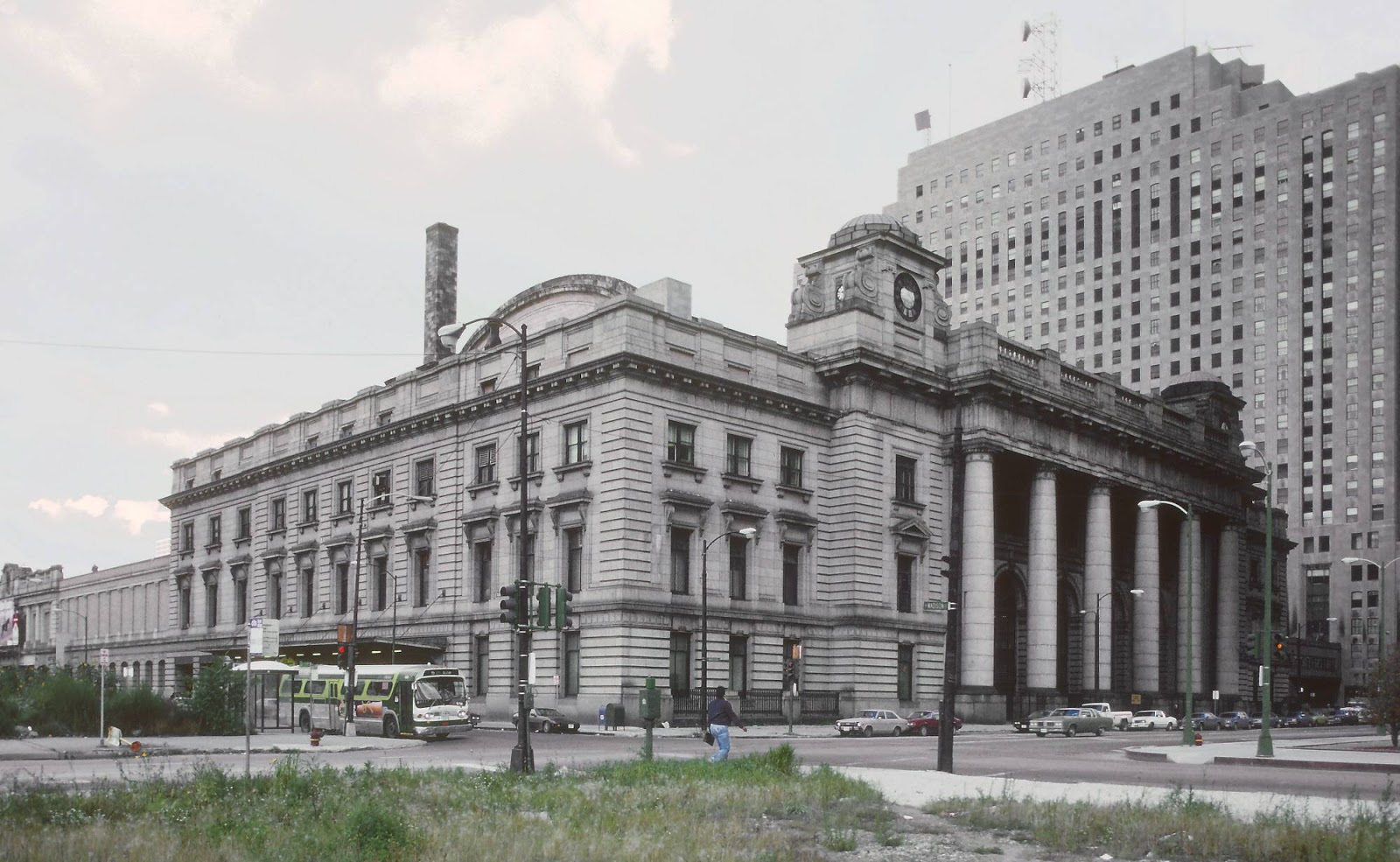
Chicago, IL Depot: C&NW Chicago Passenger Terminal (CPT), More Photos

The C&NW depot's main posting is long enough that I thought these eight Roger Puta photos that Marty Bernard posted are worthy of their own posting. They were taken in November, 1981. Update: another posting
Marty Bernard shared
A Roger Puta photo, 5

A Roger Puta photo, 6

A Roger Puta photo, 7

A Roger Puta photo, 4

A Roger Puta photo, 3

A Roger Puta photo, 1

A Roger Puta photo, 2
A Roger Puta photo, 8

Noach Hoffman posted
Birds Eye view of the Northwestern Depot. Undated. Barriger Collection. Mercantile Library. University of Missouri, St. Louis.
David Daruszka: Chicago' first "modern" railroad terminal.

Jim Arvites posted
View of Chicago & North Western rush hour commuter train preparing to depart downtown Chicago circa early 1970's.
(Henry Huehl Photo)
Brian A Morgan: The departing train is departing from the very track in which the 400 used to board and depart from. Where engine # 512 is; Is the track in which the Union Pacific / C&NW / SP Overland Limited used to arrive and depart from. The next two tracks closer to the River away from # 512 is where the City of San Francisco and the City of Los Angeles used to depart from. Half the station complex was used for intercity Passenger trains and the East tracks for Commuter services and locals. Locals consisted of trains to Milwaukee, Madison, Lake Geneva, Rockford and points less than 200 miles from Chicago.

Jon Roma I'm glad Roger documented this glorious station before it was so rudely turned into rubble in order to clear the way for a soulless office tower. But at least the replacement is a functional downtown railroad station worthy of Chicago – unlike present-day LaSalle Street Station.

Timothy Leppert We used to see a watchmaker there to have the balance wheel repaired on our pocket watches. One CBQ Engineer had a pocket watch that chimed the time when closed. He said on steam he could open then close it and place it on his ear to hear the time. My pocket watches go back many Generations in my family. Nice to have.
Mitch Markovitz The jeweler at the depot was Eddy Lurgio, Terminal Jewelers. A great guy and friend. When he retired at the time the depot was being torn down he moved to Sandwich, Illinois. I went there a few years back and couldn't find him.

Urban Remains posted nine photos with the comment:
john vinci kodachrome slides of the chicago and northwestern railroad terminal (1911) before and during its demolition in 1984. the station was designed by architects frost and granger and built by the george a. fuller company.
the station's exterior was indiana limestone. the interior was dressed with terra cotta furnished by the american terra cotta company. the walls were adorned with richly colored green grueby tiles made by the grueby tile company of boston. the ceiling consisted of light cream-colored guastavino tiles. all of it destroyed.
courtesy of john vinci collection.
David Daruszka shared
Robert Bertram: It was a historically designated building which corrupt people managed to bypass. After so many great buildings were leveled, by 1983, we should have known better.
David Daruszka: Robert Bertram It was not a historic landmark. I worked with a group of people who submitted the building for landmark designation. That status was rejected after public hearings, clearing the way for the buildings demolition.


Jeff Nichols posted three photos with the comment: "Train sheds, Chicago & North Western Passenger Terminal.   Catalogued 1900-1915.   I will venture that this is not an image from the Wells Street station, but from the new station that opened in 1911.   LOC"
1

2

3

Mark Llanuza posted
A view of the former CNW [CPT] station with Metra fleet .today they call this the Ogilvie Transportation center
John Martin: I was hogger on a few of the work trains they used to haul away the old train shed as they demolished it and also brought the new structural components you see in the photo to be unloaded and erected. Out with the old, in with the new.


Jackson, MS: IC Coal and Water Towers and Turntable

Dennis DeBruler shared
Tony Howe shared this photo to the group: Illinois Central/Gulf Mobile & Ohio/Illinois Central Gulf Memories. His comment:
Looking north from the new Woodrow Wilson overpass ca1938-40 at North Jackson, MS. The railroad called this point where the line to Canton and the line to Yazoo City split "Asylum".
Thomas Dorman The coaling tower is probably one built by the Ogle Company for IC in 1915, with a 500-ton capacity.

Note a water tower as well as the coaling tower. Wood towers were probably much more common than I had guessed because only the concrete ones have survived to the 21st Century.

Satellite
On a satellite image, we see the turntable still exists. In fact, it looks like they built a couple of new stalls on the roundhouse footprint. If they needed long stalls, why not build them just a couple more stalls clockwise from their current position and avoid having to build "wedge" ends?


Sunday, December 25, 2016

Streator, IL: CB&Q Roundhouse and Depot

Railyard: (Satellite, South of Broadway between park and Vermillion Streets.)
Roundhouse: (Satellite? I could not find it on a 1939 aerial photo.)
Depot: (Satellite)

Kerry Bruck posted
CB&Q Roundhouse on the corner of Park and Broadway in Streator Illinois.
Richard Fiedler 2 stalls are elongated with a dormer.
Andy Zukowski posted
CB&Q Roundhouse on the corner of Park and Broadway in Streator Illinois.
Thomas Whitt shared

Note the lever in the lower-left corner used to turn the turntable. Looking closer, I see there is an "armstrong" lever on the other side as well. It makes you hope the pivot in the middle and the rollers on the sides are clean and well greased. Turning the engine that is under the dormer on the right must have been "fun."

Satellite
I remember when studying the railroads of Streator that both of CB&Q's branches, Ottawa, Osewgo & Fox River Valley and Illinois Valley & Northern, met in this area. But the turntable does not show up in this old aerial photo as well as they normally appear.

1939 Aerial Photo from ILHAP

The roundhouse was the terminus for the OO&FRV branch that came from Aurora and the IV&N branch that connected with the mainline in Zearing.
1927 Streator Quad @ 24,000
 
Digitally Zoomed

Andy Zukowski posted
CB&Q U28B's on Train #85 at Streator, Illinois on February 11, 1967.
Trenton Dominy: I didn’t think this line was strong enough for the U-Boats to operate on.
I know where this is also the industrial spur to the Owens glass plant.
Harold J. Krewer: Trenton Dominy, the BN regularly assigned SDs to Fox River Branch trains because the climb northbound out of Wedron with sand loads was (still is) a killer.
Pre-merger, however, Trains 85-86 originated in Cicero and operated down to Streator and then back northwest up the IV&N to LaSalle. Four-axle units (including braces of F units) were typical on 85-86.
It might also be a case of this was all the Clyde diesel house had to spare.

Trenton's comment caused me to research how the CB&Q accessed the Illinois-Owens glass plant. On the north side of the plant, the CB&Q shared an industrial spur with the NYC, on the left, and the Santa Fe, on the right, on the north side of the plant. The CB&Q also had an industrail spur on the south side of the plant. Given the southern spur was in a residential area, Andy's photo is obviously of the northern spur.
1939 Aerial Photo from ILHAP

The track for the southern industrial lead has been removed from the dirt, but it still hasn't been removed from the concrete.
Street View, Oct 2022

Not only does the track still exist in all of the crossings, some of them had been rubberized.
Street View, Oct 2022
.

Depot


Andy Zukowski posted
Burlington Depot in Streator, Illinois. 1978
Michael Mcclanahan: Where about was this?
Richard Fiedler shared
Andy Zukowski posted again with the same comment
Trenton Dominy: This building is also still standing today it serves as a recycling center.
The old hotel building next to it was torn down in 2001.
Richard Fiedler shared

Kyle Adamic responded to Michael's question

Street View, Oct 2022

Street View, Sep 2015

John Burt posted
The old CB&Q depot in Streator. 1915
Connor Bounds: Currently a recycling center
James Brown: This wooden depot was replaced by a brick depot 1929-1930. The CB&Q depot upgrade coincided with the replacement of the ATSF wooden depot with a more substantial brick structure that still stands today. The CB&Q's 1930(ish) replacement depot still stands as well, and as indicated above in the comments, is a recycling center.
Richard Fiedler shared

That was a lot further south and east than I would have guessed. That is in the Wabash RR area. I got a detailed view of this area.
1939 Aerial Photo from ILHAP


Cairo, IL: M&O Engine House

John P. Kohlberg posted three photos of Mobile & Ohio's engine house in Cairo, IL with the comment:
Couple of images of GM&O's not often photographed downtown trackage at Cairo, Illinois in March 1967. Images taken by and courtesy of Clyde L. Anderson.
1
This is the map that taught me that M&O's facilities were on the west side of Cairo while the Big Four's were behind the M&O and on the south part of town. (The IC was on the east part of town.)
2

3