Water Tower: (Satellite)
This is not the same tower because it was taken along the Amtrak Crescent route. I'm "parking" this photo here because I can't figure out which town this one was taken in.
Roundhouse: (Satellite)
Depot: (Satellite)
Ted Gregory posted two photos with the comment:
https://www.google.com/.../@37.6772806,-80.../data=!3m1!1e3
Ted Gregory posted two photos with the comment:
Remnants of the old C&O yards in Hinton, WV.Hard to grasp the size of the coaling tower.I am standing on a hillside about the size of the bluff across the river. Those aren't overgrown weeds, they are trees.Also note the CSX double track main behind the tower along the New River.Photos from Oct 2015Dennis DeBruler It looks like their water tower may also still be standing:
https://www.google.com/.../@37.6772806,-80.../data=!3m1!1e3
 |
| 1 |
 |
| 2 |
 |
| American-Rails.com posted Chessie System power await their next mine runs at the Hinton, West Virginia terminal during October of 1981. Today, this location has been reclaimed by Mother Nature. Rob Kitchen photo. |
 |
| Chris Clark, Apr 2017 |
 | ||
| Ghost Rails and Forgotten Highways posted The C&O built a 17-stall roundhouse at Hinton, West Virginia, and 540 jobs with it — then diesel arrived and the town lost two-thirds of its people. The Chesapeake & Ohio bought land on the New River in 1871. About six families lived in the vicinity then, in three houses. West Virginia created Summers County on February 27, 1871, and made the place its seat. The town was laid out in 1874 and incorporated in 1880, when the census counted 879 people. By 1892 the C&O had completed a roundhouse with 17 engine stalls and a car shop with a capacity of 40 cars. Those two buildings employed 540 men. The depot was rebuilt in brick the same year. Hinton did not attract a railroad. The railroad measured out a division point, and a town assembled itself around the payroll. The census tracked what the payroll did. Hinton counted 879 people in 1880, 2,570 in 1890, 3,763 in 1900, and 3,912 in 1920. In 1927 the town took in the neighboring settlements of Avis and Bellepoint. The 1930 census counted 6,654 — the highest figure Hinton has ever recorded. The downtown built in those decades is still standing and still legible. The Hinton Historic District, listed on the National Register in 1984 and revised in 2005, covers 80 acres and contains 212 contributing buildings, plus one contributing structure that is a railroad water tank. A town that size needed banks, newspapers and a hospital, and it had them. Then the locomotives changed. A steam engine had to be coaled, watered, fired, cleaned and repaired, and Hinton existed to do all of it. A diesel needs no coaling tower, no ash pit, no roundhouse gang. In the 1950s the conversion from steam to diesel hit Hinton alongside changes in coal mining methods, the working out of older mines, and the local abandonment of coke making. The C&O laid off hundreds of workers. Those jobs were not seasonal and did not come back. Population fell in 1940, 1950, 1960, 1970, 1980, 1990, 2000, 2010 and 2020 — nine straight censuses without a single decade of growth. Today fewer than 2,300 people live in Hinton. The West Virginia Encyclopedia puts the 2020 count at 2,266 and calls it a 65.9 percent decline from the 1930 peak; other tabulations of the same census give 2,245 and 2,263. Whichever figure you take, roughly two of every three residents are gone. The roundhouse is gone as well — one local account dates its demolition to 1983. The coaling tower is not gone. It stands in the photograph here, concrete going green under vines with the New River still running past it, and the Library of Congress notes that towers like it remain in place because demolishing such massive structures costs too much. Amtrak's Cardinal still calls at Hinton, three round trips a week between Chicago and New York, over a line CSX runs freight on. That is what is left of the connection that built the place: a train three days out of seven, and a concrete tower nobody can afford to take down. Towns like this sit all through the Alleghenies — laid out to a railroad's specification, staffed to its timetable, and left holding the buildings when the technology changed. If you grew up in Hinton, or had family on the C&O payroll there, what did the yard look like when it was still working, and what year did your household stop counting on it? Ghost Rails and Forgotten Highways: The Avis Overhead Bridge at Hinton, also called the Main Street Bridge, was built between 1927 and 1930 by the city government and the C&O together to replace an at-grade crossing. It carried vehicles until 2003 and is still standing. Photo: West Virginia Collection within the Carol M. Highsmith Archive, Library of Congress, Prints and Photographs Division. |
 |
| William A. Shaffer posted Coaling Tower . (Photo by William A. Shaffer) |
 |
| Rob Kitchen posted Eastbound train arriving at Hinton, West Virginia, in 1981, past CW Cabin at the extreme west end of the yard. The was one of the last towers to close on the old West Virginia Division. T.J. Gaffney The operators in this cabin were the last ones to see the Allegheny crew the blew up. Testified in the FRA docs that they could hear the low water alarm screaming as it went past. [I could not find Chillicothe, so I don't know if he is referring to this accident.] Update: the evening after I wrote the above, I came across the comment on a post of the other accident: Carter Jones I believe they [C&O] had 2 incidents. One was 1953 With an Allegheny and then this one in 1948.] |
 |
| Rob Kitchen posted The remains of CW Cabin, in Hinton, West Virginia, in the summer of 2007 |
 |
| Robert Slavy posted Hinton. 1978? Dennis DeBruler: Hinton in West Virginia? |
Depot
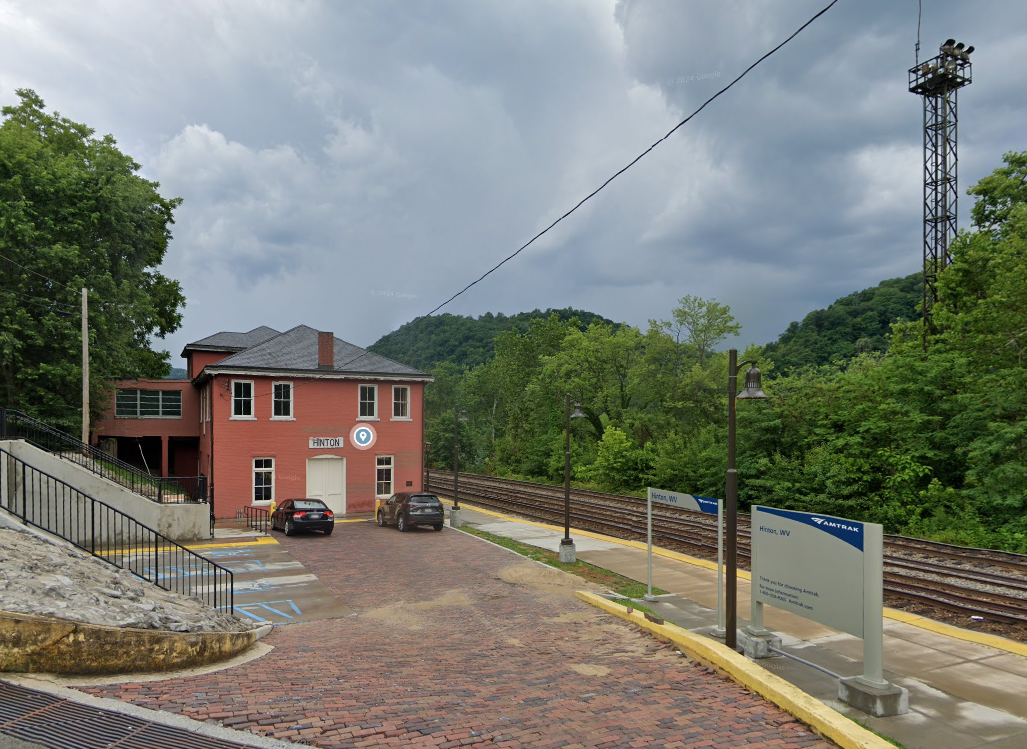 |
| Street View, Jun 2024 |
 |
| RE Pearce posted Former C&O, now Amtrak, station in Hinton WV |
 |
| Ted Gregory posted Amtrak Depot Hinton WV My pic Apr 2, 2023 Dennis DeBruler shared |
 |
| Richard Lutz, Apr 2023 |

No comments:
Post a Comment