Showing posts with label rfGragg. Show all posts

Tuesday, November 15, 2022

Mentone, IN: Cargill Animal Nutrition and Wood Feed Mill

Big Feed Mill: (Satellite)
Little Feed Mill: (Satellite)

Street View

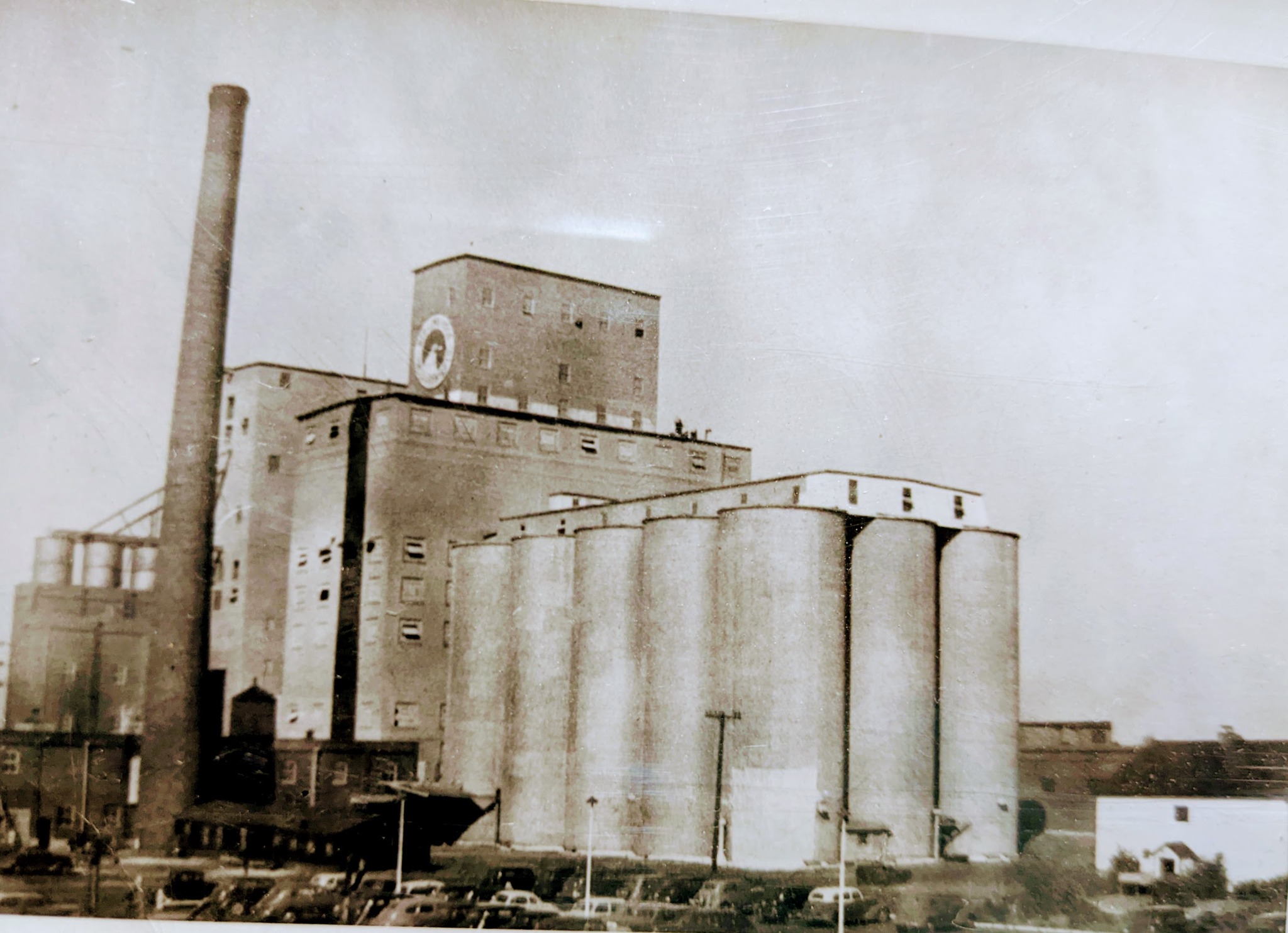
This feed mill was founded by some people that worked for Hale & Hunter to support a local pekin duck farm.
Bob Bowerman posted
Ok, this one I just found. The "shacks" around the base of the stack are not how I remember that area looking like when I was just a very young toddler. The area was all brick. If I have my directions right I think "the lab" was just out of sight from the bottom right of the photo. bobb
Michael Brandt: Bob Bowerman your correct about where the lab was and the Cafeteria isn't there yet.
Bob Bowerman: Oh, man! That's awesome! I haven't revisited these childhood memories in decades! I mean I can remember the steam coming out of a vent in the bottom of the stack and I can still remember the sound of the whirling sound of the cables on the powershovels used to unload boxcars of bulk ingredients would snap taunt when the cluch popped and it reversed direction. They had steam shifters then as I remember. I think they shut the stack lid when they were close to entering the unload area and when they came out they open up the smoke stack a big cloud of sooty smoke followed by a blast of steam (white smoke) would shoot skyward. we little kids loved it.

Michael Brandt commented on Bob's post
the Laboratory still stands. [I looked for it on a satellite image, but I could not find it.]
Bob Bowerman: Michael Brandt Your kidding! "The Lab" as my dad referenced it, was the nursery where the likes of Brick Meinert and Dr. Mike Kelly and you could probably throw my dad in the group, began their careers that went on to provide the science-based foundation that lead to the rise of Maple Leaf Farms (Maple Leaf Duck Farms) of little 'o Milford Indiana, as the largest producer of Pekin ducks in the western hemisphere. Brick was the "man in the duck house" observant, innovative. Dr. Kelly was out of Missouri hill country, he became MLF's nutritionist and was a pure numbers guy. His favorite saying was, "Figures don't lie, but liars always figure". This was usually said as he finished dismembering a feed ingredient salesman's presentation that was based on poor or purposely biased research. He just utterly despised phoo-phoo dust magical claims. My dad brought expertise in making pelleted duck feed that he acquired with his tour of duty at H& H to the table. I worked with all three of these guys and never heard a bad word about the "Hales Lab". All three were quality driven, science-based managers. I remember my dad coming home from work one day sometime after H & H had been bought out by a large (to remain unnamed) international grain company, in a very somber mood. (At the time MLF was the largest feed account for the H & H Mentone mill, which my father was manager) He and mom sat at the kitchen table with dad talking in a quiet tone about something going on at the mill. I remember my dad saying, "Bert Hales must be rolling in his grave, if he's seeing this". Not long after that my dad left H & H and went to MLF and supervised the building of it's own feed mill designed specifically for making duck feed. He always pushed quality and recognizing the frailty of man, stressed "it ain't a mistake until it goes out the door", as a way that encourage errors in production to be reported instead of covered up. He managed the MLF mill until he retired. The quality orientation and science-based production methods had had long roots reach back to "The Hales Lab". This probably more than you wanted to know, but I'm 70, this history shouldn't be forgotten when I die. bobb
[Another photo of the lab]

Bob Bowerman posted
Back to Riverdale!
Very similar to earlier photo. This where you folks can add color commentary. I don't recognize a lot of this picture. I have no idea what the small white building to the right is. If you look close, there's two rr cars of coal at base of stack. I looked close at the white patch on the silo base. When I blew it up, it looked more like a concrete repair job, not white paint. From my experience it was either structural failure (not likely) or they had a silo fire. Silo fires at the bottom of a silo are indicative of poor housekeeping and/or poor ingredient rotation Getting the last of an ingredient out of a silo before refilling is labor intensive and not a lot of fun. Often this step is skipped and the bottom of the can gets older and older and starts to break down due to microbes feasting on the old/moldy bottom layer. Microbes give off metabolic heat and free moisture as they multiply. The additional free moisture speeds up the cycle dramatically. Temperatures go parabolic and certain areas begin to smolder. Fire department called and concrete wall is jack hammered open and pick and shovels are used to break clumps open and soaked down by firehose. bobb
Michael Brandt: Bob Bowerman do you remember the chicken coops? They were in the area where the camera was pointing. But that white building is a mystery 🤔

Bob Bowerman posted

This not in Chicago but Mentone Indiana.  this is the mill I thought of as our second home.  I made a few adjustments to make some things easier to see.  I don't know what you know about operating feed mills but I'll walk you through this one;
The mill is still under construction as there is no manlift in the back right side.
The mill is brand new, not a single hammer mark on the silver bin bottoms.
The guy smoking is probably the truck, bulk feed loadout person, down from his crows nest below the coned bulk feed bin bottoms and  directly above the 80' truck scale.  The guy in the suit is my dad.  You never wear a suit in a mill...unless it's Grand Opening!
The other guy is the mill super and the back guy is the pellet mill operator.  In Chicago the pellet mills were up on the 2nd? floor.  Pelleting feeds made the nutrients more bio-available and H&H ran hard on that fact.  The got the duck feed biz because ducks hate eating mash.  FCR (feed conversion ratio) improved dramatically when you switched to (H&H) pelleted feeds.  This mill is like a HO gauge scale model next to Riverdale. bobb
Brett Ellis: Is this the mill that became Cargill (Nutrena)?
Bob Bowerman: yup.
Brett Ellis: I shipped screenings to Fairbury in the late 70s.
Bob Bowerman: Brett Ellis Always "weavil_free", right! 😉 I probably got pd from all the weevilcide I splashed on myself fighting those little buggers. Screening made excellent feed except it concentrated the mold toxins and grew wevils like crazy.
Kurt Altmann: That’s craziness smoking in a mill !! Grain dust is a bomb.
Bob Bowerman: Kurt Altmann It was just a different time back then.
Kurt Altmann: Bob Bowerman Im thinking they different fire up the hammer mill new mill I worked at Acme Evens Flour Mill the mill started before Indiana was a state. Smoking and chewing tobacco was not aloud. You could smoke in the break room that’s it. We had a few roll fires scary times!!!!! Thunderstorm came one night and hit the roof blowing up the 8 floor on the wheat side it was like a bomb went off blowing out windows.
Bob Bowerman: Kurt Altmann Acme Evens?? Hhmm, I used to buy midds/reddog from them. Out of the Chicago or was it Indy? And yes, flour mills figured out dust explosions way ahead of everybody. This doesn't work all the time but when it does it really impresses the little kids; Sometime when you are having a campfire with kids, you need the kind of fire an adult likes to make smore's over, not a kid. You need some flames, but not a roaring fire. Take a kitchen flour sifter, the old type with a mesh basket, fill it with some flour. Hold it above the flames and give the sift lever 1-3 quick pulls. If everything goes right (you need flames but not an updraft so strong the flour can't fall) the flour falls like a minifog cloud, the flames ignite the first particles and the density of the cloud of flour is such the ignition jumps to the particles nearby. Under ideal condition the flame front passes up through the flour dust cloud extremely fast, probably burning the hair on your wrist, each kid goes home with the intention of trying this out on their own. You are their hero. bobb

Zooming out, I found this poultry farm nearby.
Satellite

Big Boy 2006:
I missed this wood grain elevator until I saw this photo. It looks like they turned on the smoke for the rail fans.
Robby Gragg Flickr
Mentone
UP Big Boy 4014 leads the Coast to coast excursion East through Mentone, IN passing an old grain elevator.

Street View, Jun 2023

Monday, May 23, 2022

Duluth, MN: CN/DM&IR #5 and #6 Ore Docks

(Satellite)


David Schauer posted
This was during a three-week USWA strike in 1956. Note all of the Pittsburgh Steamship Division boats in temporary layup at the DM&IR Duluth docks. There is an active laker unloading coal at the Boston dock on the far left, possibly the Cliffs Mather? Basgen Photography
Carl Dahl: Even the crane ship Clifford Hood was there in lay up. [Third boat from the right.]
Michael Lackore: That is indeed the William G. Mather unloading to the far left.
I can't identify them all but I can get a few of a the Pittsburgh boats. The Clarke, Callaway and the Anderson are moored closest to the shore of Dock 6 ( right side ore dock) not neccessarily in that order. Off the starboard stern of the Eastern-most one of those three is the Cifford F. Hood with the dual cranes on deck. At the Eastern side of dock 6 at the end, facing outward, is the William E. Corey. On the opposite side of the dock, sporting the dual, spar-deck houses in the John W. Gates. The Gate's sisters, The James J. Hill, Issac Ellwood, and William Edenborn, all sporting their singular spar-deck houses, are there too. Lastly, the most visable of the two boats moored at the end of the West side of Dock 5, is the Henry C. Frick.
Rick Schroeder: If we proposed each ship averaged 650' long, that's over 3 miles of freighter!
Fred Overeem: During that strike many freighters were layedup in Muskegon lake. My friend an I had a boat that we used to visit crew members.

David Schauer shared
John R Decator: I remember the 56 strike, although I thought it was longer than 3 weeks. My dad was Chief Engineer on the Harvey that season. My mom drove in convoy with three other families from Marine City, Michigan, to spend time with our dads. Took the moms three days of driving. My dad rented a trailer on a lake outside Duluth, and we fished and swam with him.
James Torgeson: John R Decator The ‘59 strike was a long one.
 
David Schauer posted
A Basgen aerial view of DM&IR's Duluth docks in 1961. The coal dock on the right is quiet as steam was essentially done on the Missabe, although there is a cut of loaded cars on the dock. I'm not sure by this date where Duluth Works received their coal from, possibly private docks or the limestone dock seen in the middle of the image with a boat being unloaded. Also, note the Missabe SD on the Duluth Transfer Railway (NP) near Dock 5. The cars appear to be loaded. The Boston Coal Dock is to the left of Dock 5. The number of inactive lakers suggests a downturn in business or a strike or some sort (I couldn't find note of a major strike in 1961). Lots to enjoy in this view. Duluth, MN - June 13, 1961 - Basgen Photography
Craig Nelsen: David Schauer There was a National Maritime strike in June 1961... Star Tribune 16 June 1961 Page 11
Craig Nelsen: What's interesting, is that this photo was taken the same time as the MN DNR's aerial photo's for 1960's. I wonder if that is who the DNR contracted with? EDIT: I guess the DNR photo is labeled 7/7 1961.
David Schauer posted
A Basgen aerial view of DM&IR's Duluth docks in 1961. The coal dock on the right is quiet as steam was essentially done on the Missabe, although there is a cut of loaded cars on the dock. I'm not sure by this date where Duluth Works received their coal from, possibly private docks or the limestone dock seen in the middle of the image with a boat being unloaded. The Boston Coal Dock is to the left of Dock 5. The number of inactive lakers suggests a downturn in business or a strike or some sort (I couldn't find note of a major strike in 1961). Lots to enjoy in this view. Duluth, MN - June 13, 1961 - Basgen Photography
Christian Bastian: The Boston Coal Dock became Hallett 5 the dock off to the right of Dock 6 is gone along the with the other coal dock to far right. Is all that correct?
David Schauer: Christian Bastian Right. The Lakehead pellet storage area now takes up the space to the right of the docks. Part of the limestone dock is still visible.

John F. Lawrence posted
Duluth Ore Docks and freighters circa 1900–1915. Source: Detroit Publishing Company and Library of Congress.

Sreenshot from a Live Cam mounted on Lincoln Park Middle School (source)

David Schauer posted
Some interesting things to see in this flashback from spring 1956 as boats from the Pittsburgh fleet fit-out for a new shipping season at the DM&IR docks in Duluth. There is also a bum boat in the near slip passing by the Anderson (if you zoom in you can see crew on planks painting Arthur). Next to the Anderson is the Callaway and their sister Clarke is in the middle of the grouping on the right. Lengthening and conversion to self-unloaders is in their distant future. The Boston coal dock (now CN-Hallett Dock 5) is on the left. Basgen Photography 1956

David Schauer posted
A flashback to 1959 from the Basgen files of the Col. James M. Schoonmaker at DM&IR Dock 6. An unidentified Great Lakes Towing tug is assisting. Basgen Photography
James Torgeson shared
The Str. Col. James M. Schoonmaker of the Shenango Furnace fleet loads ore in Duluth in 1959. She survives as a museum ship on the Maumee River in Toledo, OH.
 
Al Miller posted
Enders M. Voorhees takes on its first load of the season on March 29, 1966, at DMIR Dock 5 in Duluth. This is a Duluth News-Tribune photo in my collection.
Jam Mclean: Video’s I see today show only 4or 5 chute’s down at a time. Looks like 15 in the hatches in this picture. Why all these down in the sixties ?? If the boat moved the chute’s would be damaged???
[I saved this photo because all of the chutes were down. And because we can see the hatch crane.]

David Schauer posted
Nice late afternoon light illuminates the Great Lakes Trader (and Joyce) arriving at CN to load pellets for Cleveland while across the bay the PRT finishes up loading coal for St. Clair. June 11, 2017.

David Schauer posted
Sykes at Sunrise
One of a handful of steamers still plying the lakes, s/s Wilfred Sykes loading at CN 6 in West Duluth at sunrise this morning. 12/30/2021
 
David Schauer posted
The Paul R. Tregurtha on one of its infrequent visits to CN Dock 6 in Duluth. The Tregurtha loaded ore for Cleveland, another location she probably doesn't visit all that often. Duluth, MN - April 29, 2023
Judy Barnes-DePeal shared
[The stockpiles in the background are looking full. I wonder what is covered in plastic.]
 
David Schauer posted
I always like when the conveyor shuttle booms lower in unison, as seen here at CN Dock 6 with the Anderson loading ore for Cleveland. The classic laker would depart later under the cover of darkness. Duluth, MN - September 28, 2024

Chris Mazzella posted
James R Barker backing to CN 6 in Duluth this morning, while the Great Repulic undergoes misc repairs on the east side of 6.
Stephen H. Lawson: Nice shot of a little bow thruster action!

Crypto Photography posted
May 1971
Kevin Keller shared

Note that there are locomotives on each of the trestles.
Digitally Zoomed
 
Kent Rengo posted
A trio of Missabe SD's are seen on Dock 6 in this mid 1960's. The exact year of the image is not known but the groundwork for the new Lakehead Storage Facility which started in late 1964 can be seen in the background. Photographer unknown. Missabe Railroad Historical Society collection.
Sebastien Poisson: That's high off the ground ! Still there ?
Kent Rengo: Sebastien Poisson the image was most likely taken from the old ore dock offices that were closer to Dock 5. That office was removed in the early 1980's when a new building was built next to Dock 6.
Connie Sharpe: It’s so different underneath the ore docks since the freeway went through! Hard for me to picture what it looked like, pre freeway.

Greg Mross posted
Don't think I posted this one before.... BN 199 has a cut of coal cars in tow as it passes the Queen of the lakes, the Edward Ryerson, under the DM&IR ore docks in October of 1993.

Al Miller updated
This week’s banner photo shows Arthur M. Anderson arriving at CN 6 in Duluth to unload limestone, with the Cason J. Callaway loading at the gravity chutes. It was shot July 10, 2010, by Chris Mazzella. He posted it here last winter.
 
Dave Blaze Rail Photography posted
Pure Duluth
I'm looking forward to getting back up here in a week so to get in the mood here's another take on one of the coolest catches from my fall 2023 trip. 
A CN Proctor Yard crew (perhaps R922) is unloading ore on massive Dock 6 (built by the Duluth, Missabe and Northern in 1917) with a trio of rebuilt ex SP tunnel motors, CN repainted BLE 906 and DMIR 408 bracketing orange BLE 909, and a set of vintage 70 year old Missabe hoppers.  Down below is the CPKC transfer returning to their home base in the ex Soo Duluth yard at Rices Point after making a turn east across the Grassy Point Draw to Superior via BNSF's ex Northern Pacific running tracks. 
Berthed up taking on a load of iron ore is the American Steamship Company's American Spirit. The self unloading bulk carrier was built in 1978 by American Shipbuilding of Lorraine, OH for the National Steel Corporation, to be managed by Hanna Mining Company and was originally named the George A. Stinson.  At 1004 ft long she was the 7th thousand footer on the Great Lakes and one of 13 still sailing (including one which is technically and ITB). 
Duluth, Minnesota 
Wednesday October 4, 2023

This video taught me that the vertical things in the front part of the dock are conveyors instead of chutes.
Screenshot
The mighty Anderson loading up in Duluth in heavy rain for another run south to the Gary Steel Works in Gary, IN.

Robby Gragg posted
As seen from on top of a bluff above Duluth, MN, the IC 6251 departs the dock with ore empties.

Kent Rengo posted
Frosty flashback from sometime in the early 2000's. Cason Callaway unloading pellets at the former Missabe Dock 6 in West Duluth MN.
[Some comments confirm that unloading an ore ship would be very rare here.]


Dan Mackey posted
Here's a panorama I created of the DM&IR docks in West Duluth, we we're working one of the empty coal train set jobs headed for the NSSR when I got this one. Bonus with the Presque Isle at Dock 6. 11/01/2009
Dan Mackey shared

The CN/Duluth, Missabe & Iron Range ore loading dock with ore storage piles. (Update: Dock 5 describes the now abandoned dock that is next to the active Dock 6.)
Satellite

Wayne Ciampaglia posted
Illinois Central SD on Duluth ore dock 5-25-14

David Schauer posted
Hatfield loading taconite pellets on the east side of Dock 6 Duluth during an unseasonable cold snap in December 1972. Missabe Railroad Historical Society Collection
 
Richard Wicklund posted
From the Skyline Drive in Duluth, overlooking the Missabe ore Docks on June 9, 1973. Three Tin Stackers, left to right: Robert C. Stanley, peaking around the right ore dock, the Leon Fraser, with the Henry H. Rogers at the Hallett Dock unloading across the slip. Notice that the Superior Midwest Energy coal dock across in Superior was not there yet.
Steve Miller: When did they stop using that right dock?
David Schauer: Steve Miller 1985
Al Miller: Cool to see all those bridge cranes.
Steve Miller: How did the bridge cranes work?
Richard Wicklund: Those docks across in Superior worked the same as the one on the right where the Henry H. Rogers is being unloaded. A bucket on the crane moves out and lowers it into the hold of the ship. Also the entire crane moves on rails up and down the slip adjusting to the ship. The crane unloads the bucket in the proper piles, or in reverse, can load the ship.

David Schauer posted
The new Algoma Strongfield takes on a cargo of UTAC pellets at CN's Dock 6 in West Duluth for Quebec City (for eventual movement to Europe). This is the first trip to the Twin Ports for the Strongfield, which was delivered recently from a shipyard in China as part of Algoma's fleet modernization program. June 18, 2017.
Marty Bernard posted
DM&IR ore docks in Duluth, MN on March 16, 1984. Walt Dunlap photo

Screenshot
[Look at all of the workers on top preparing to unload.]

Chris Mazzella posted
J.P. Morgan Jr. ( William P Palmer behind her), Thomas Lynch and Percival Roberts Jr, tied up at DM&IR Dock 6 during the US Workers strike. July 17, 1959

March 2018: Twin Ports Rail posted
Spring is here and so is the shipping season. The James R Barker backs into the slip at CN Dock 6 in West Duluth while a BNSF coal train unloads across the bay and a roadswitch job with IC 6252 works the dock. This is the first ship of the season for Dock 6, loading UTAC pellets. March 22, 2018.
Jose D Nevarez No chance CN will open the other bridge?
Twin Ports Rail Nope - eventually will be scrapped.
Gary Luskey Does alot of grain still get loaded on to ships up there yet?
Twin Ports Rail Not much relative to 20 years ago. Spring and fall still see some decent activity.

Robby Gragg posted
A former DM&IR tunnel motor rests on the Duluth dock. Duluth, MN

Wayne Ciampaglia posted
Illinois Central SD on the Duluth Ore Dock 5-25-14
Mark Strock Never seen this dock in action, are they going up or coming down? I imagine they are winched up.
DaBob Olson Optical illusion, the tracks are actually level, the picture is taken from above and at an angle. I have been to Duluth, no dock is going up hill like that. But it does make you think.
Picture taken from Skyline Parkway Overlook. https://www.google.com/.../data=!3m1!1e3!4m5!3m4...


Is Anand shared a Marco Delgado post
Fred Babin Interesting to see the ship discharging cargo prior to taking on a load of iron ore pellets.
Brandon Lee Many of these lake freighters haul limestone, coal or other commodity up north on the return trips.
Dennis DeBruler And the UP Big Boy is a bonus.

David Schauer posted
Arthur M. Anderson loading on the west side of Dock 6 in Duluth. Minntac pellets for Great Lakes Works. 8/2/19

William Brown shared a David Schauer post
Ultimate rail & sail combination. Timing is everything, and everything came together this evening as three trains converged at Dock 6 in Duluth while the distinctive laker John D. Leitch loaded ore. Great light and color with the shadows holding off long enough to get all three trains unobstructed. Canadian railroads and boat plus all EMD. Credit skillful piloting by Gus with composition/exposure and framing assist from dad. 8/6/19

David Schauer posted
CN job R921 spots cars for dumping at CN Dock 6 as the Oakglen loads export pellets for Quebec City (eventually Europe). 11/15/2021
David Campbell: Will the Oakglen offload I'm Quebec and then load another ship to Europe or will she stop in Quebec and then continue on herself?
David Schauer: David Campbell Off load in Quebec City and the ore will then be loaded into a deep draft vessel for Europe.
David Campbell: David Schauer thanks, didn't think she would travel the ocean but wasn't sure. So she's just ferrying the ore to the ocean side of the St Lawrence. Thanks!
Michael Sofie: Looks like she ran into something.
David Schauer: Michael Sofie Tight Seaway locks.

David Schauer posted
There is so much to see in this aerial of the Superior-Duluth harbor. My guess is 1983 given the Bong Bridge is under construction (opened in Oct 1984) and CRH cement silo (opened in 1983). A saltie is loading at Elevator M in the lower left while the elevator on the adjacent dock is being torn down. Lots of older lakers still occupying various slips before being scrapped. Enjoy this Friday Basgen flashback. Basgen Photography
Kent Rengo: Looks like a boat at DM&IR Dock 5. By that time maybe would've been rare?
David Schauer: Kent Rengo Stopped shipping in 1985 so the end was in sight.

Digitally Zoomed

David Schauer posted
Blough's Last Visit
Roger Blough loading at CN Dock 6 in Duluth on July 2, 2020. After unloading this cargo the laker would be put into layup, only to suffer a serious fire at the shipyard. The Blough was recently towed from Sturgeon Bay to Conneaut (CN-owned dock) to await final disposition, likely scrap given it has been stripped of critical components). 7/2/2022

David Schauer posted
A different take on the Burns Harbor departing CN Duluth with UTAC production for Indiana Harbor. Arthur M. Anderson will shift forward to the shiploader. On the hillside is Duluth's Lincoln Park middle school. 11/23/2022
[As a comment pointed out, this is a great comparison between a "footer" and a previous generation of ore boat.]
 
David Schauer posted
Score Four...
Clyde S. VanEnkevort/Erie Trader departs C. Reiss and passes CN Dock 6 on its way to load ore at Silver Bay. I thought it was interesting that Clyde took the north channel to/from Reiss (notice how close it is to the dock). Duluth, MN - May 12, 2023
Jon Clark: Didn’t realize it’s down to 3 tracks up there now
 
David Schauer posted
Hard to beat two EMD sets, one with three tunnel motors. In the busy limestone season CN will call a noon job that usually overlaps with the day job around Dock 6, making for some nice photo opportunities. Here with have 406/909/903 spotting ore cars on Dock 6 while a Minorca limestone load heads up the run down track with 408, 6263 and 6253.  Icing on the cake is veteran laker s/s Arthur M. Anderson loading at the dock for Indiana Harbor (historically an infrequent destination for her).  Duluth, MN - June 30, 2023

1 of 8 posted by Jacob Wickman 
Federal Yukina was in port this week to take on a rare load of ore at CN 6. This is the first time I’ve ever seen a saltie load at this dock. Another saltie, Heerengracht, also made a rare visit to Two Harbors for ore last year. I’m curious if this is slowly becoming a more common sight. I didn’t have enough time to catch her departure thru the piers so we ended up catching her at the rose garden. Next stop is Rotterdam.
 
David Schauer posted
Another interesting size comparison between the footer Walter J. McCarthy Jr. and laker Philip R. Clarke. The McCarthy loaded ore for Cleveland and the Clarke for Indiana Harbor. Duluth, MN - September 23, 2023
Travis Irwin: No wonder so many traditional lake boats were scrapped as the Footers came into service.

Michael Konczak posted
John G. Munson at the CN dock in Duluth with black smoke, Thanksgiving 2023. Photo by Michael Malachi Pike: Isn’t she one of the last of the Bradley transportation Freighters?
Maxwell Crosby: Malachi Pike she is the last.
Malachi Pike: Maxwell Crosby can always tell a Bradley boat just by deck house on the bow.
 
David Schauer posted
Today CN tested the door opening mechanisms on their new ore cars with a trapping machine at Dock 6. Day job R921 brought the 5 cars down and then returned them to Proctor after the testing was complete. They will never be this clean again. Duluth, MN - December 4, 2023
Kent Rengo: We've had a number of members question where the cars were built so instead of burning up the comments with the same question here's the original link you can review.
https://www.facebook.com/groups/280781616123369/permalink/1397744381093748/?ref=share&mibextid=NSMWBT
Robert Warrick: What is a trapping machine?
Kent Rengo: Robert Warrick Machines used to open and close the doors on the ore cars. One can be seen among the sea of people in PPE.
Pierre Evans: Is that a National Steel car product?
Doug Stark: Pierre Evans No, the recent ones are from Freightcar America. Some of the 2009-built cars were from NSC.
David Schauer: Christopher Westley Illinois Central SD40-3 No. 6251 (an ex-BN SD40-2). One of many that were assigned to the former DM&IR over a decade ago. Note the white frame stripe, a rarity these days (most are yellow).
Chase Andrews: Why are they so small?
David Schauer: Chase Andrews Two main reasons - the dock pockets are on 24-foot centers, so the ore cars are designed for that (dump over every-over pocket). Also, ore is very dense/heavy, so these can be filled to the top without going over their rated capacity.
Bill Walker: David Schauer there must be a reason as to why their rated capacity is only 175 000#?
David Schauer: Bill Walker They can only be 24' long and go only so high before they became top heavy. Those are the two biggest constraints.
Mel Wilson: Bill Walker like Dave said, the pockets are on 24’ centers. The BNSF ore cars are too long if that helps give you an idea. You can only cram so much in one little space, and it would be too costly to upgrade the dock.
Joshua Benedetto: Hilariously enough the Bessimer and Lake Erie used to use coal cars for their ore carrying duties for a long time. However they used to fill them to around half full to avoid overloading the cars.
Bill Kloss: Joshua Benedetto Not hilarious at all. Erie, Nickel Plate, Wheeling & Lake Erie and other roads that hauled ore used standard coal hoppers for carrying ore. The 24' cars were used by the roads that had the mines as shippers. Pennsylvania/Penn Central/Conrail used them as well for the C&P dock in Cleveland.
[There are several comments about seeing these cars roll north in Texas. The link provided by Kent confirms that the cars are being built in Mexico.]
 
I saved this photo because it provided the terminology of "trapping machine" and "shuttle booms."
David Schauer posted
Trapping machines open and close doors on ore cars as CN's night job waits to pull cars off Dock 6. Note the shuttle booms are starting to lower to feed the Mesabi Miner. Lurking in the distance is classic laker John G. Munson, tied up awaiting electrical repair. Duluth, MN - April 24, 2025
Bill Buss: David Schauer are the trapping machines what the rail cars dump the ore into?
David Schauer: Bill Buss No, the little machines that open and close the dumping doors on the ore cars. You can see three on the right side.

Bjornberg Photography posted three photos with the comment:
Mountains of iron:
The MV American Century arrived before dawn this morning to load iron ore at CN. This afternoon, I was able to catch the thousand-footer loading shortly after a train arrived at the ore dock.
Jeremy Nichols: when I grew up in Superior in the 1950s and 1960s, we were told the iron ore was running out and even taconite wouldn’t last much longer. Clearly that depressing prediction was wrong. What changed?
Randy Ufholz: Iron ore is located using geological mapping, magnetometers (which detect magnetic disturbances caused by underground ore), and exploratory drilling to sample potential deposits, often searching for magnetite or hematite. Modern techniques also include satellite imagery analysis to map mineralogy.
Since the 1950s and 1960s, iron ore exploration has advanced from basic geological mapping to sophisticated, technology-driven methods. Key advancements include airborne geophysical surveying (magnetic and electromagnetic), advanced isotope dating and chemical analysis for deeper analysis, and refined ore genesis models. These allow for deeper penetration and detection of hidden deposits compared to early methods.
1
[This was posting near the beginning of the shipping season so the stockpiles are still large. They were built up during the Winter when shipping on the Great Lakes shuts down because of ice.]

2

3

Of particular interest is that you can see the booms going down.
1:25 video

0:21 time-lapse movie of a ship leaving this dock and going out the ship canal