These are notes I am writing to help me learn our industrial history. They are my best understanding, but that does not mean they are a correct understanding.
This is not a conveyor over a Class I railroad because this Wabash route is now owned by the shortline NDW.
Note the hopper cars on the siding in the background. This appears to be another example of a rail-served elevator that does not have a fall protector.
And across the street is a wood grain elevator. Is (was?) this a feed mill? This elevator (Mercer Landmark) participates in a big feed operation, but the feed is now produced at other locations.
"MPS Feed specializes in the efficient production of Poultry feed for layers and pullets for customers throughout Western Ohio and Eastern Indiana." [MercerLandmark_feed]
Are those hopper cars in storage rather than serving this elevator?
(Photographer Unknown - Collection of William A. Shaffer)
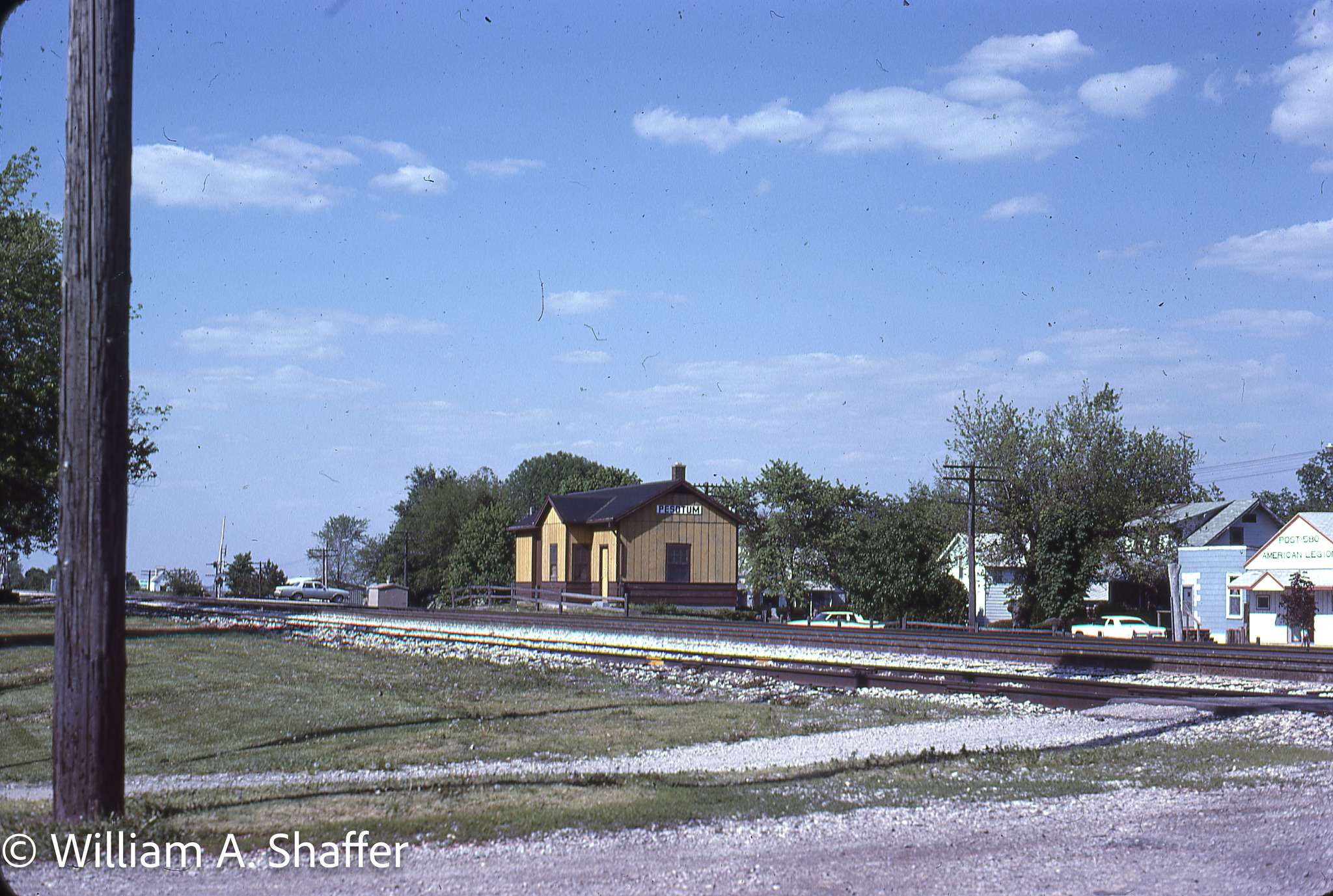
This is as close as I can get to the view in William's photo. Note that William's photo doesn't have to two big bins. The bins appear in a 2014 street view, which is the oldest one that is available.
David L White posted The old Wabash depot in Antwerp, OH, still open, in 1973, I know it was moved to the west edge of town and I believe it still exists today.
I'm disappointed that this map marks the depot as a square instead of a rectangle.
Since David's post said that the depot lasted to the 1970s, I was curious how the grain elevators changed. And we can see the dormer on the roof in this photo.
In another beautiful J Parker Lamb photo, the northbound Illinois Central Creole speeds past the station at Pesotum, Illinois behind a classic IC E-6 believed to be number 4001. Three express reefers and at least seven baggage cars hide the train’s coaches behind the grain elevator. Lower quadrant semaphores control the two-track main.
The photograph is part of the Dillon Collection at the Illinois Railway Museum’s Strahorn Library. The Strahorn Library houses thousands of books, tens of thousands of periodicals and more than a hundred thousand photographs, all centering on the subject of trains and railroading and all held to support research and scholarship into the railroad history of the United States. It is at 118 E. Washington Street in Marengo, Illinois, is normally open from 10AM to 2:30PM on Wednesdays, and visitors are welcome. For those unable to visit, we can provide access to our collections via telephone (815-568-1060), e-mail (strahorn@irm.org), or online catalog (librarycat.org/lib/IRMStrahornLibrary).
All materials are provided only for non-commercial purposes according to the “fair use” provision of U.S. Copyright Law which permits use of copyrighted material for criticism, comment, news reporting, teaching, scholarship and research.
[Source: Dillon 1803, Strahorn Library, Illinois Railway Museum. Posted by Jan Young]
William Kammer: Express Reefers: Strawberries or Bananas... I know that Strawberries used to come into Chicago on the City of New Orleans.... Employees magazine did an article on them.
I got the topo and aerial before I discovered that the depot is extant. It is still interesting to note that the depot did mark the location and the aerial also shows the IC used to have a lot more mainline tracks.
1950 Tuscola Quad @ 62,500
The IRM photo shows that the wood grain elevator in 1940 got replaced by silos, but a satellite image shows that the town no longer has a grain elevator. That is probably because there are some big elevators in Tuscola just a few miles down the road.
William A. Shaffer posted Amtrak Depot & Sunset Station. (5.11.00) San Antonio, TX (Photo by William A.Shaffer). John Mier: Sad they are no longer using Sunset Station. Beautiful building! [I think it is good that Amtrak moved out so that the building can produce revenue. It looks like they use the revenue stream to pay for preservation and maintenance.]
When I saw that the Amshack was an existing building, I wondered if it was the "colored waiting room." But looking at the filled in doors in the photo, I think it might have been the freight house.
Marty Bernard posted two photos with the comment: "Southern Pacific San Antonio, TX Depot in 1973. Bill Howes photo, Reid Adams collection"
Edward Miller: AMTRAK No Longer Uses the station Anymore but one a bit further down however they do still use the Platform.
Edward Miller: They Use it For Weddings and Party Venues Nowadays but there is a Nice Southern Pacific Steam Locomotive on Display at the End of the platform.
Power Plant: (Satellite and Satellite, the coal handling facility has been repurposed as a barge-to-land facility)
Railyard: (Satellite and Satellite, once again, the brownland of a rail yard is now used by cleanup companies)
Mason Reed posted The Gulf Coast Rebel on a turntable at Tolson yard.
Randall James: ALCO DL-105, really rare, only two 105's were ever built #'s 270 & 271 , #272 was the only true ALCO DL-109 the GM&O owned, was built in 1940 for the Gulf Coast Rebel St Louis to Mobile AL 1940-1958
Russ Hawkins posted That is a power plant right across the river, right at — 2 mile south of the arch in ST. LOUIS, MISSOURI. It is still there, it had 24 boilers, that provided steam to a common steam header, - - > > that went to 6 turbine generators. All of those boilers and turbine generators made - on a good day - 240 Megawatts. The picture was taken in 1953. Tim Stehle: Multiple boilers feeding a common "low pressure" header in early days was fairly common. Esp as boiler tube metallurgy was still developing, so loss of a boiler wasn't a huge hit on capacity, as Boilers were often "under rated".
If 24 truly were common headered to 6 units, turbines and FW were clearly simple cycle. Of course, dedicated FW heating to improve efficiency in a 24 -to-6 arrangement would be complicated - extraction stage steam quality from many identical units at different loads would not provide a stable FW inlet temperatures for distant boilers.
All of that said, one header could have been used but normally segregated between groups of four boilers to feed two units, and the ties lines opened only when "emergent".
Plus process improvements in later years could be hidden behind the brick. If not for plant like this, "Chinese Laundries" might still be using scrub boards and clothes lines 🙂
All in all, a nice post and source of wonder on how we got to today from the initial plant facilities such as this.
John P. Kohlberg posted two photos with the comment: "ICG(GM&O(M&O)) Tolson Yard - East St. Louis, Ill., circa 1982, Long Photography Kodachrome. Cahokia Power Plant looming in the foreground."
Darion Fox: Do you have anymore of that yard? [Responses with images below.]
Dennis DeBruler commented on Darion's comment I included the Alton & Southern because it reminded me that the Tolson Yard was originally just M&O. The GM&O merger of 1947 has yet to be reflected on the map. 1949 Cahokia Quadrangle @ 1:24,000
A photo showing lighter smoke coming out of the stacks.
Joel Flickr, 2009, License: Creative Commons Attribution-Share-Alike (CC BY-SA)
Cahokia Power Plant
This monolithic coal powerplant was completed in 1939 and deactivated in the 1970's. Since this is such an imposing landmark, I'm sure some awesome photographs have been taken of this structure, this is not one of them. Lol.
This was taken from the Missouri side of the Mississippi River looking across into Illinois. Apparently the property is still being used by a river transportation company. I'd love to take a look inside.
I've seen the same text on multiple web sites. I believe this is the source of the description.
BuiltStLouis [This page has several more photos] The power plant circa 1954. Scan from "St. Louis Views", Will Shelly, publisher. "The Union Electric-operated plant first came online in 1923; it was built in stages and completed in 1939. Designed to burn Illinois coal, it was the largest power plant in the Mississippi Valley when it opened. Its boilers consumed a ton of coal every 30 seconds, and over 600 million gallons of water a day. Underwater cables fed the electricity produced to the thriving city across the river. The plant later converted to oil burning. "By 1976 the plant had been replaced by newer facilities and was decommissioned. Union Electric sold off the property in 1979. Extensive asbestos insulation used in its construction remained a problem for at least a decade, acerbated by careless salvage work. "The site today is home to Cahokia Marine Services, a multi-modal transportation business run by SLAY Industries; it functions as a bulk commodity transfer site, loading river barges. The site offers a large volume of indoor storage, presumably referring to the power plant building."
I was not able to find the rated megawatt capacity of this plant. I did find some details about its coal consumption.
Constructed in
stages between 1923 and 1926, Cahokia was the largest electrical power plant in the Midwest
upon its completion and was the first designed to burn low-grade Illinois coal in pulverized form....The Cahokia
Power Plant was equipped with fourteen boilers and consumed coal at the rate of one ton every
30 seconds. This represented seventy-six carloads of coal every day and 1,250,000 tons of coal
per year. After arriving at the plant in train cars, the coal was dumped, run through a drier, and
then crushed into a fine, pulverized powder that was blown into the boilers (East St. Louis Daily
Journal 30 November 1924, sec. 4, p. 1, col. 5; 11 May 1930 p.10D, col. 8; Federal Writers’
Project 1983:492). Much of the coal consumed at the power plant came from a company-owned
strip mine located outside of Freeburg in St. Clair County (Department of Mines and Minerals
1929:166, 170).6 [IllinoisArchaeology]
JakubStepanovic, this is one of many photos of the St. Louis area. Near the end are industrial ruin photos.
I don't see petcoke in this list, so I guess the black piles in the satellite image are coal instead of petcoke.
Cahokia Marine Service:
-84-acre intermodal river terminal in Sauget, Illinois
-Bulk liquid and dry products transferred in and out
-Barge, rail & truck enabled
-Products include coal, copper, steel cement & iron
-32,000 feet of railroad track with 6 locomotives
-Served by BNSF, CSX, Gateway Western/KCS & UP railroads
This photo confirms what I saw in a 3D Satellite image, they unload barges as well as load them. They also handle tanker barges. I'm presume that these silos handle cement. The powerplant building is now used as a warehouse. The coal goes to trucks, not rail.




.jpg)


