Tuesday, September 9, 2014

Homer Township Festival -- Old Tractors

The Holmes Township Festival had a nice selection of antique tractors. It even had 3 that they allowed the kids to climb on. That was a big hit, even with the girls.


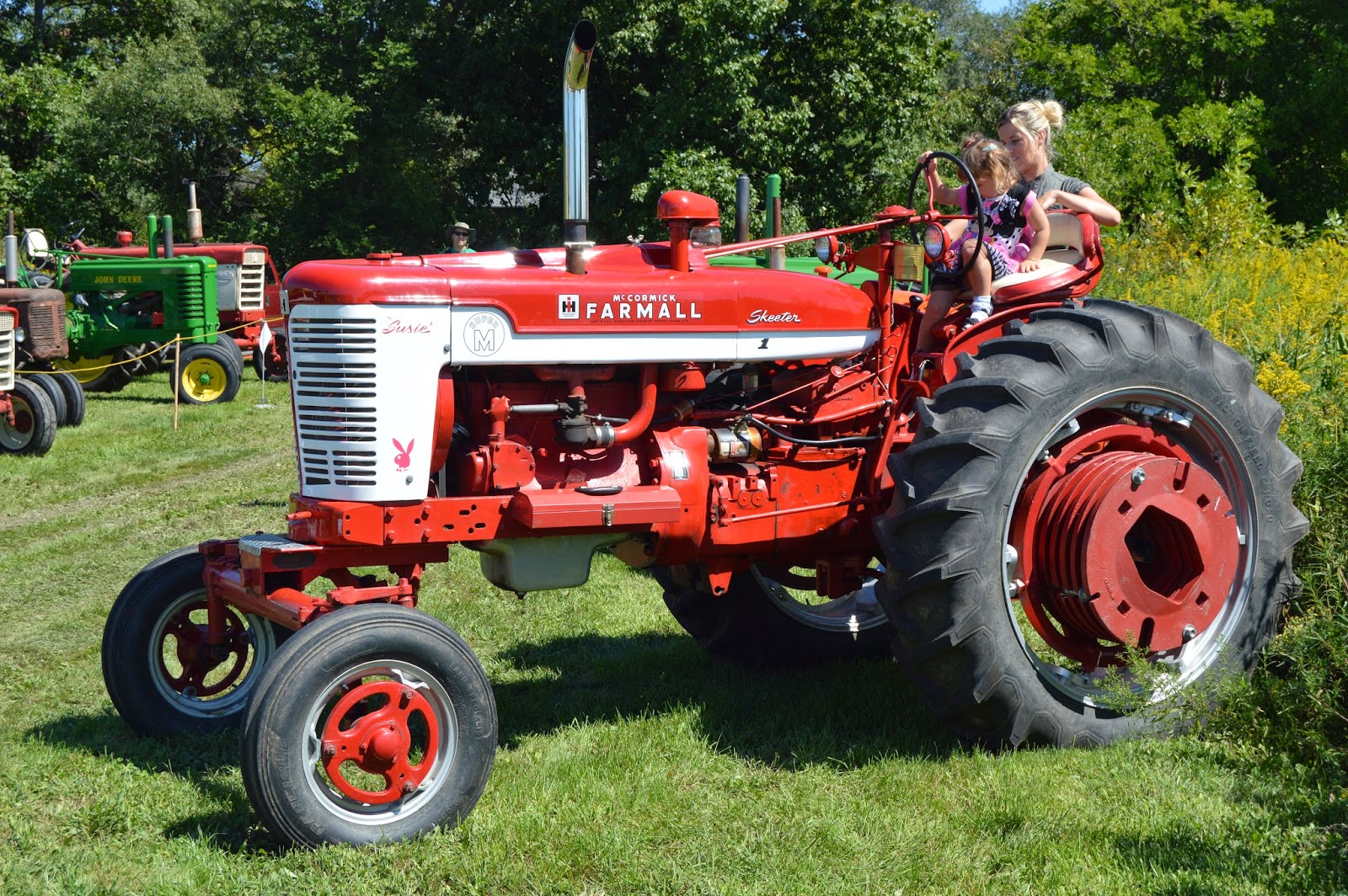
I think that is the first Farmall I have seen that has a row-crop front instead of a tricycle front. And I doubt if the bunny head was OEM. That is an impressive number of wheel weights mounted on the hub. If I remember correctly, I think each one is a hundred pounds because I was always amazed that my Grandpa could lift one by himself when they added the weights for plowing. I took a picture of the other side to see if it had weights. And to record the all important fact that this is a 1953 Super M. Note that it does not have as many weights on the right side. When a tractor pulled a plow, the right tire would be in the furrow that was left by the previous pass,  and it would have good traction. But the left tire would be up on the hard, packed dirt that had not yet been plowed, and it would have trouble getting as good a grip. So the left tire would have more weight than the right tire. In this case it looks like 5 vs. 3 weights. I am more used to seeing 2 or 3 vs. 0 weights. I also note that it has the same small belt flywheel that was on the H in Naperville. Since I know an M has more horsepower than an H, my theory that the belt pulley size reflects the horsepower of the tractor is wrong. Looking at the rear we see it has a swing drawbar and a PTO. But it does not have 3-point hitch or hydraulic circuits.
For reference, I include this 1968 JD 300 that does have a 3-point hitch. Last July I started a post on the history of 3-point hitches, so I'll have a lot more to say about them some day when I get back to that post. It also appears that the standard for PTO shields has changed. You will have to skip below to the Farmall 560 to see an example of a tractor that has a hydraulic circuit.

I could not find a date for the following WD-45 Allis-Chalmers.


Antique tractor collectors must also collect weights. Note in the first picture above that this tractor had 4 tire weights on the left tire as well. And this tractor has three front-end weights. The reason for the front-end weights was to prevent "wheelies." If the plow resisted being pulled, but the tires kept going forward because they retained traction due to the wheel weights, then the thing that "gave" is the front end would go up. So the front-end weights effectively increased the pulling power of the tractor by keeping the front end on the ground when the pulling got tough.


I circled back later when the WD-45 was "kid free" to take pictures of the rear. What struck me was that the steering wheel and seat are offset to the right. I'll have to keep an eye out for other WD-45s to see if this is the standard design. The engineers may have done that so that the transmission lever could go directly into the center of the transmission. I took a "high" picture to get a good look at all of the gauges etc. So it is not obvious if this design had a PTO. It does have a hydraulic circuit, but it is single-acting.
Next in line was a John Deere G, but I could not find a date.


It has a PTO and swinging drawbar, but no 3-point hitch. I don't know if it has hydraulics because I can't figure out what the gizmo above the PTO but below the seat is. If it is something to do with hydraulics, it does not have standard connections.

I finally have my very own picture of a John Deere putt-putt tractor. I zoomed in on the first picture above to get a view of the left side so that you can see the huge flywheel that a putt-putt needed because it had only two cylinders so the time between firings was long enough that you could distinctly hear each individual "putt". The big flywheel was needed to keep things going smoothly between "putts."
The show had a second putt-putt, and I got a better view of the left side.


Note how much air is in the "engine compartment." I believe the shaft you can see going across the middle drives the radiator fan. You did not have to worry about replacing the fan belt in these units. When I was zooming on the right-side view looking to see if it had turning brakes (discussed below), I noticed the model letter is on the seat post. Later, I noticed a sign that indicated this is a 1940 Model A.
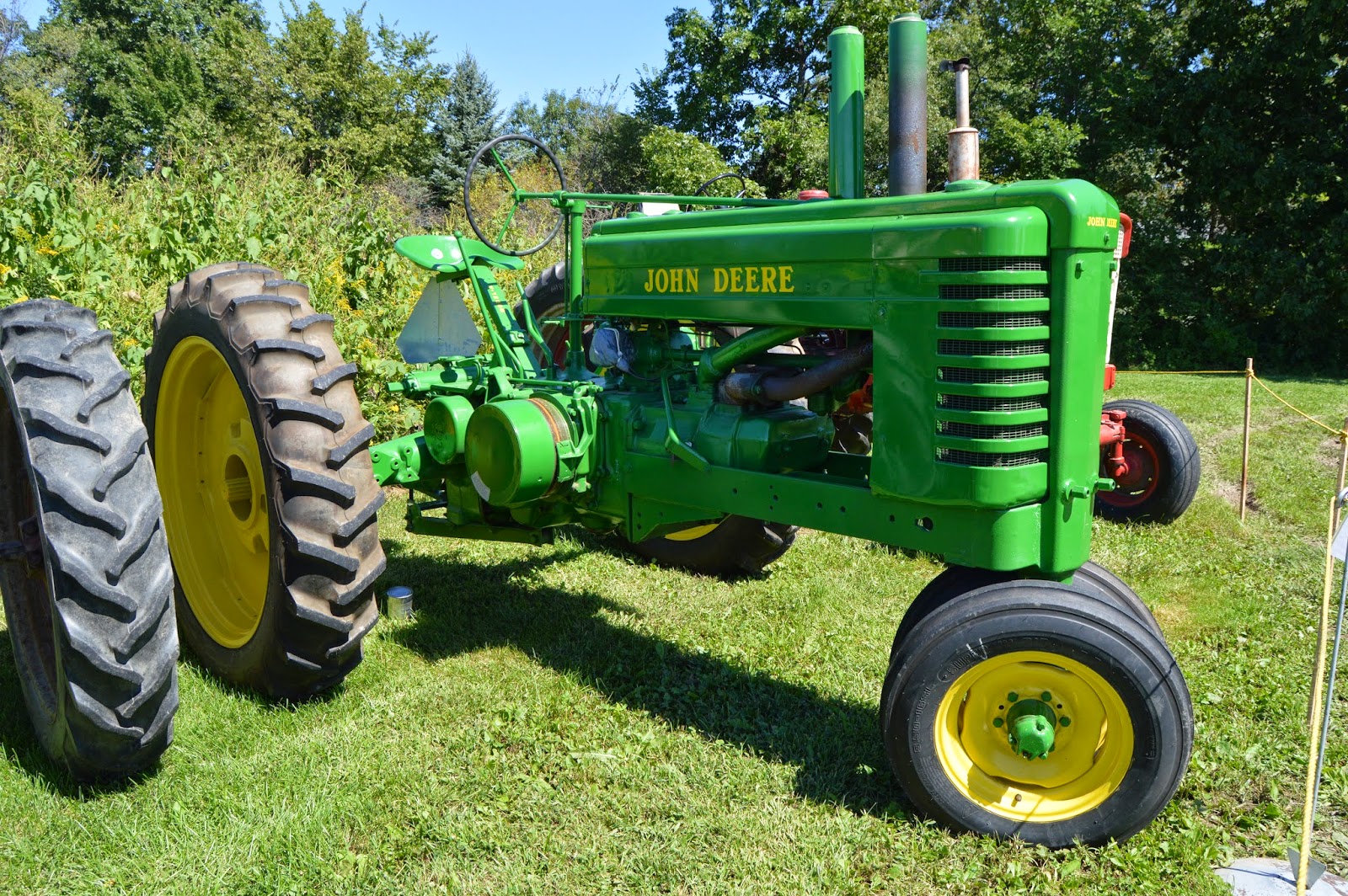
You can see that this tractor was roped off and the rear was up against corn, so I was not able to get a shot of the back of these tractors. The show also had a model B putt-putt.


This Farmall 560 appears to be in original condition -- torn seat, a little rust on the bottom of the white trim, some dirt on the transmission case on the right side. But I think I prefer a realistic looking tractor to the typical gleaming restoration job. Note that this tractor is modern enough that it no longer has a belt pulley.


Since this tractor was on the end of the roped off area, I was able to get a partial view of the rear end. The PTO shield is missing, so you can see the shaft on to which the implement's shaft would slip. Above the PTO are the connectors for one double-acting hydraulic circuit. It also has some double-acting hydraulic cylinders connected to some sort of hitch mechanism. But it is not a standard 3-point hitch.

On the right is a zooming and brightening of the pedals on the right side of the tractor. You have to look closely, but there are two brake pedals, and a little lever that is flipped over from one so that it engages the other. That means the tractor is set up for road travel. If you push on either or both pedals, the brakes will be applied to both tractor wheels. For field work, you would flip the lever back into its own pedal so that it no longer engaged the other pedal. Then when you wanted to turn the tractor, you would not only turn the steering wheel, you would step on the appropriate brake pedal. In soft soil, especially with a tricycle front-end, just turning the steering wheel could be remarkably ineffective. The wheels would just plow a grove in the soil and the tractor would keep going straight. You quickly learned how to also apply the appropriate (side and amount) of braking power when you wanted to turn. When I was studying tractor manufactures last July, New Holland bragged about the "quick steer" feature. One thing it did was automatically use the brakes to help turn the tractor. Today's tractors are like today's camera, they use computers so it is now just point and go.

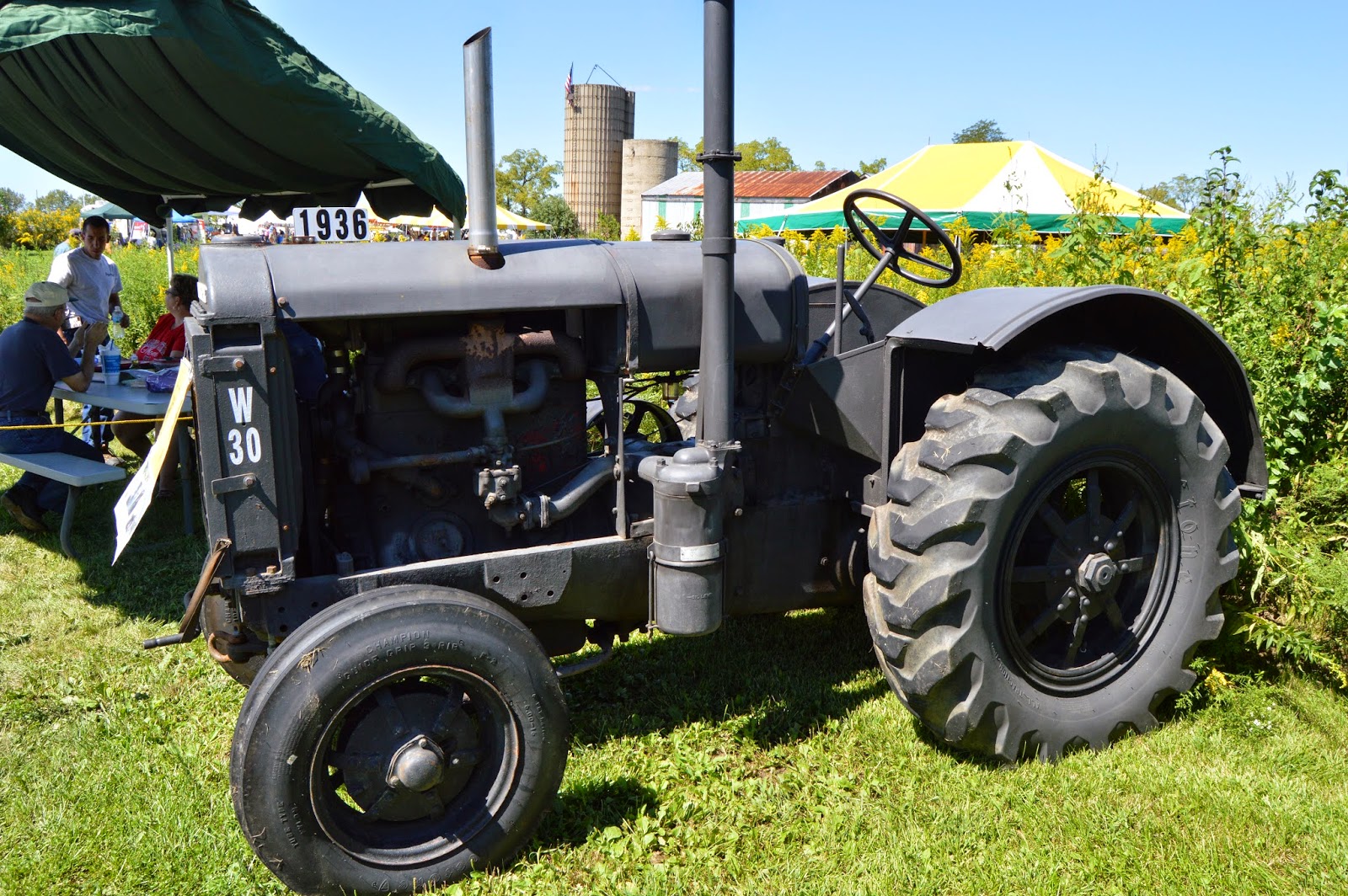
I do wish this tractor had a sign indicating the make, model, and year. I've never seen that arrangement for a steering wheel and shafts before.
And below is another International Harvester Co. tractor. (Farmall tractors are made by International Harvester.)


And the sign on the front of the tractor is:


In a different part of the farm, they had three more Farmalls. See the captions for details. And I now see that the mystery tractor above with the weird steering wheel arrangement is a Model C.

1953 Farmall Super M

1949 Farmall H

1949 Farmall Super C

And when I took the other side of the C, I included the old silos that were left on the farm.
A 1930 McCormick-Deering 10-20

Another monument to wheel weights. I had a brain burp because I did not get a picture of the rear.


Monday, September 8, 2014

Farmall H and F-30s

When I wrote the article on tractor companies, I got frustrated trying to find tractor pictures that were not Copyrighted. So I'm making it a point to go to festivals that have an antique tractor display. I probably won't revisit farm machinery manufacturing for another year or so, thus I'm posting a sample of what I find as travelogs. This will make Copyleft pictures of tractors available to others, and it will help me find pictures when I need them myself.

(Update: Farmall was originally manufactured in Rock Island.)

The event report in the newspaper for the festival sponsored by the Conservation Foundation had one picture:

And the text explicitly mentioned "vintage tractors and trucks." Since I needed more pictures of Fordson tractors, I went. Unfortunately, this year there were just 3 tractors.

I always enjoy seeing a Farmall H because I raked hay and hauled hay wagons with one when I was a kid.
20140907 0021

And I'm now trying to get pictures of the back ends of tractors to track the introduction of PTO, 3-point hitch, and hydraulic hook ups. The 1939 Farmalls had just PTO. It would be under the shield that is under the "slow moving traffic" caution sign. I think that shield is part of the specification for the PTO standard. So safety is not a recent concern.

This tractor illustrates a swinging drawbar. For implements that are centered behind the tractor such as a hay wagon, the bar would be pinned in the middle. For implements that work to the side such as a hay mower, the bar would be pinned to the right for field work and pinned to the left for transport down the road. And when the tractor is pulling a drag after a field was plowed to smooth out the "ridges", it would be unpinned so that it could swing from side-to-side during turns. One had to be careful not to turn too sharply or the rear tire would catch the drag and pull it up and over the tire. That was considered a big boo-boo.


Farmall must have designed the H between 1937 and 1939, and I never realized how "modern" it was until I saw this 1937 tractor. Note the steering worm gear that is literally "up front and center." Also the transmission raises the drive train so that the axles are high. In a view of the rear of the other F-30 below you can see there is a gear casing that lowers the drive train down to wheel hight.


A tractor design would be manufactured for years before a new design would be developed. Here is a 1932 version of the F-30 model.


When I commented that the tractor did not have a PTO, the owner pointed out that it was under the tractor and that you had to use an extension to hook up a powered implement. So I took a closer look at the above picture and zoomed in on the PTO and increased the brightness. You can see the PTO shaft on right side of the gear case.


If you click the picture, you get a bigger version. Then you can also see the "ripples" on the gear casing left over from the sand mold that was used to cast the casing. Notice in the above rear view that the axle is not connected directly to the wheels. It is connected to a gear casing that provides another layer of gear reduction. In the following view of the right-side you can see that the fly wheel is driven by the same gear casing that powers the PTO.


I believe this horse-drawn sickle-bar mower is a permanent display at the farm. It took me a while to find a view of the gear case that did not have my shadow in it. The top of the gear casing has the words McCormick-Deering. The gear casing contains gears that drives a shaft going forward from the axel. Below is a closeup of the wheel at the end of the forward oriented shaft. It is hard to see in the grass, but a bar is connected to that wheel off center.

As the wheel goes around and around, the bar will go back and forth. The bar, in turn, drives the sickle back and forth.

This farm also had signs explaining the construction techniques for old barns. But I can't find any of the pictures I took of their reconstructed barn!

Saturday, September 6, 2014

Downers Grove, IL: Mochels Hardware Store

When we moved into Downers Grove in 1976, Mochels Hardware Store was still in the downtown area selling True Value hardware. It was one of three True Value hardware stores and two other hardware stores in town that are now gone. I assume they were victims of the "big boxes." It was a neat old hardware store. It had the smell that is unique to old hardware stores and part of a wall consisted of little boxes that contained fasteners and other little fiddly pieces of hardware. And it was staffed by the owners and they knew where to find stuff.

The text of the following plaque that has been mounted on their old building reads:

Levi Mertz and Charles Mochel constructed the original building at 36 S Main (later renumbered 5122 Main Street), where the 2 partners opened their business, Mertz & Mochel, on June 25, 1884. The building consisted of a basement and 2 stories, utilizing wood columns, beams and floors, and was bordered by alleys on the south and west. Electricity was added in 1900.
In 1922, Mertz sold his interest to Charles Mochel, who formed a partnership with his son, John Mochel, Sr.  The business was renamed Charles Mochel & Son. Also in 1922, by closing the alley to the south, the Mochels expanded the building for the first time. Next came the 1932 facelift that changed the store front to what is seen today.
After Charles' death in 1946, John Sr. renamed the business Mochels Hardware, establishing its legacy under that title.  The ambitious 1955 expansion doubled Mochels building in size. The main and second floors were extended above the newly excavated basement addition, all reaching the west alley.
John Mochel Jr., joined his father, John Sr., as partner in 1957. In 1960, just a year after the store's 75th anniversary, John Sr. passed away. From that time, John Jr. was the sole proprietor until Mochels closed in 1995, ending 111 years of serving residents of Downers Grove and neighboring towns. Mochels is the only centennial business on Main Street in the history of Downers Grove.
 The Mochels Hardware building is a tribute to the three generations of Mochels who were actively involved in local government , civic organizations, and community service, greatly influencing the development of the Village of Downers Grove for over a century.

20140828 0044
The plaque confirms that Mochels Hardware is spelled without an apostrophe, which is consistent with Downers Grove. Below are some photos the DG Historical Society posted on their Facebook account to commemorate the dedication of the above plaque.

1890, DG Historical Society 1900, DG Historical Society
Sometime between 1922 and 1932, DG Historical Society 1924, DG Historical Society
1934, DG Historical Society 1954, DG Historical Society
1994, it looks like Easter is coming, DG historical Society

The stone at the peak on the left side of the building records that it was built in 1923. And the current owners have retained the ornate tin ceiling.


Michael Matalis posted
Ceramic plaque found while digging thru the kitchen this morning. About 6"x6"

Per Bob Lalich's comment below, these are the photos. The prices of 5.97, 3.67 and 1.88 are a reminder of how much the dollar has inflated.
1

2

3


Monday, September 1, 2014

Downers Grove's Sears Homes

Downers Grove, IL, (DG) claims to be the Sears catalog home capital of the world. (Roadside)  Some 300 were assembled, and many still exist. And at least 40 of the possible 450 models of homes are represented. The number of 27 in the Wikipedia is wrong. That is the number that is included on the trolley tours that are held four times a year.

Sears started selling "house kits" in 1908 and called them "Modern Homes." And "modern" was not just hype.  They had central heating, indoor plumbing, electricity (Wikipedia), and drywall instead of lath and plaster. (Examiner) 70,000 were sold before too many defaults on mortgages during the depression caused Sears the exit the home business in 1940. Sears Homes has examples of some of the home catalog entries that Sears offered.

The homes were affordable, attractive and saved the buyer 40 percent of the cost of labor because of precut milling, he said. There were no power tools then, and with the kit homes, local carpenters would not have to measure and hand cut each piece of wood. (ChicagoTribune)
DG had excellent team tracks so it was relatively easy for the carpenters to unload the 1-3 boxcars shipped for a house. Each boxcar contained about 30,000 numbered pieces. It was still a challenge to transport the material with horse and wagon, which is why most of the houses are built within 4 blocks of the team tracks.

DG is a nice place to live. So some people are buying older, smaller houses so that they can tear them down and build a new, big house on the lot. That is, an old house is "scrapped." I hope that realtors are being careful not to sell Sears homes to people who intend to scrape the house. Downers is making an effort to preserve its Sears homes and to survey its architectural heritage.

Update:
Carl Venzke posted
Mr. Davison's house arrived at the train station in a boxcar containing about 12,000 pieces. Loaded with much care and forethought, these massive boxcars were packed to the ceiling with building materials. Most likely, the building materials were shipped from a massive Sears mill in Cairo, Illinois.

Carl Venzke posted
Excerpt from an Aladdin Company brochure demonstrating how a kit house could be shipped from their Bay City headquarters in a single railway box car (1952).
Screenshot at -1:48 (source)

Facebook Reel

Facebook Reel