National Park Service
 |
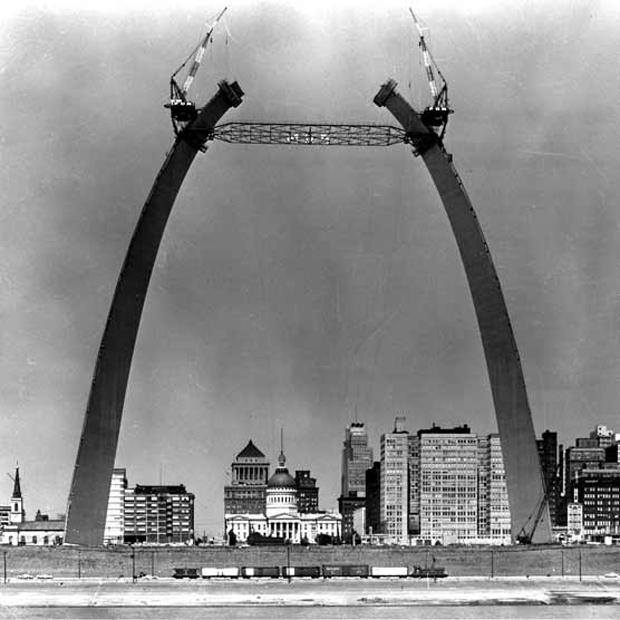
| Steve Robinson posted The placing of last link in the Gateway Arch, 1965, in St. Louis, Missouri. Marty Mullins Still find it hard to believe how far up the cranes climbed before the brace was installed between the two halfs |
 |
| Lamiya Sopner posted The Gateway Arch - Missouri Located in St. Louis, it stands as the tallest monument in the U.S., reaching 630 feet. Designed by architect Eero Saarinen, it symbolizes the westward expansion of the United States. Completed in 1965, the arch is made of stainless steel and is part of the Jefferson National Expansion Memorial. |
 |
| Alex Thomas posted St. Louis, Missouri History: Photo-The last piece of the Gateway Arch being fit into place by cranes, 27 October 1965. The Gateway Arch is a 630-foot-tall monument in St. Louis, Missouri, United States. Clad in stainless steel and built in the form of a weighted catenary arch, it is the world's tallest arch and Missouri's tallest accessible building. |
 |
| Gateway Arch posted |
This view shows the safety net between the arch and the brace.
 |
| Missouri History Museum from Pinterest |
Adding the keystone segment was an event that attracted a lot of photographers.
 |
| Mike Kelly posted A cool piece of history of one of Missouri’s most recognizable features. |
 |
| Charles Sympson commented on Mike's post My brother took this photo. |
My wife and I rode to the top in the 1970s. You don't want to take that ride if you are claustrophobic. There is an elevator on a slight slant that will take you part of the way up, but you are left with a lot of stairs to climb. This is a case where a picture is worth a thousand words. Each five-car "train" follows a track up the inside of an arch leg. Each "car" has a ring and pinion that hold a drum. The drum is attached to the ring so that the drum can turn as the slope of the track changes. I remember there was enough friction in the roller bearings so that you would start slanting and then the drum would jerk upright.
Steve Robinson posted two photos with the comment: "I'm not sure if this is an old pic of the Gateway Arch getting built and then getting some maintenance done or both of it getting built over the years."
 |
| Modern Mechanix from Pinterest |
 |
| 1 |
 |
| Forgotten Railways, Roads, and Places posted [This is the first time I have put a photo from one posting between the photos of another posting. But I wanted to put the "keystone" lift in chronological order.] |
.jpg) |
| James Torgeson shared Ironworkers from Pittsburgh-Des Moines Steel (PDM) place the final segment of the Gateway Arch. John Jauchler: Wasn’t it slightly off kilter and they had to use jacks or such to get that last piece firmly in place? Jim DeMontmollin: John Jauchler they also used fire hoses to cool down the legs because the sun caused the structure to expand. Billy D. Wadkins: John Jauchler Yes and Pipefitters had to do the welding on the inside because the IW's couldn't take the heat! LOL [Pipefitters work in boilers and are used to the heat?] Arthur Godfrey: Mt boss was an engineer on that job. He said that the last section came up short a few inches and they just waited for the sun to warm everything up to expand it and it closed the gap. Barry Messner: Lukens Steel in there. Heritage Documentation Programs, NPS posted 🎂 Happy Birthday🍾 to the Gateway Arch (Jefferson National Expansion Memorial) at Gateway Arch National Park! This photograph shows the final #stainlesssteel section being fitted into the Gateway Arch on this day, October 28, 1965. The #arch was designed by Finnish-American #architect Eero Saarinen in 1947. [Robert Arteaga, photographer] LEARN MORE See the Historic American Engineering Record (HAER) and the Historic American Landscapes Survey (HALS) documentation of this historic site in the HABS/HAER/HALS Collection in The Library of Congress at https://go.usa.gov/x7brq |
 |
| 2 |
 |
| James Vaughn commented on Steve's posting Poplar Street bridge construction in the foreground. |
 |
| Vintage St. Louis & Route 66 posted [Has several other photos and a long comment about the history of St. Louis.] James Torgeson shared Pittsburgh - Des Moines Steel (PDM) places the final section of the Gateway Arch in late October 1965. The components were fabricated primarily at PDM's plant on Neville Island near Pittsburgh, and were transported to St. Louis by barge and rail. Kevin Tomasic: The shop buildings where PDM built this are still in place and are used as a steel warehouse. They receive barges of steel. My little brother does the maintenance on equipment in the building. It's a monster shop. Matt Cawley: I watched a documentary on this. When they went to place the final piece there was a big rush to do it early in the morning before the sun heated the it up cause the thermal expansion would make the ends not line up. James Torgeson: Yes, the St. Louis FD was there hosing down one of the legs to get it into proper alignment for the installation of the final section. James A. Kenny: chicago bridge did the stainless welding .. James Torgeson: Interesting on CB&I. The SS sheet was made at USS Homestead. |
 |
| Vintage St. Louis & Route 66 posted August 24, 1965 - The huge "PDM" letters on the stabilizing strut between the legs of the Arch were removed, ending a dispute between the National Park Service and Pittsburgh-Des Moines Steel. The Park Service claimed the letters were an advertisement for the prime contractor on the job. James Torgeson shared A different view of the Gateway Arch being built by PDM. |
 |
| David Gulden posted |
 |
| Crane CN posted Terry Penick: That crane is set up on the St.Louis Arch. |
 |
| Angel Maria posted Arcing legs of the Gateway Arch under construction at the St. Louis Riverfront, September 1964, with the north leg, background, at 300 feet [91m] above ground (the completed arch would stand 630-feet [192m] tall). Structural engineer Bob Mohr, foreground, examines "post-tension bars" at top of the south leg's construction. The SS Admiral excursion boat, upper right, moors on the Mississippi River below Eads Bridge, along with the Goldenrod Showboat under renovation. Photograph by Arthur Witman for the St. Louis Post-Dispatch, copyrighted by the State Historical Society of Missouri, with digital image for non-commercial use. |
 |
| History’s Mirror posted The St. Louis riverfront in 1942, shown here after the sweeping demolition to clear space for what would eventually become the Gateway Arch, reflects a moment of profound transition in the city’s history. More than forty blocks of aging warehouses, industrial buildings, and riverfront businesses were removed as part of an ambitious plan to reshape the downtown landscape. What had once been a dense and lively commercial district tied to steamboat trade and early westward expansion was suddenly reduced to wide, empty ground. In this cleared expanse, the city’s past met its future. Though the Arch itself would not begin construction until the early 1960s, the demolition in 1942 marked the real starting point of the Jefferson National Expansion Memorial. The photograph captures the quiet aftermath, where the river flows alongside a stripped shoreline that had been central to both St. Louis commerce and identity. Wartime conditions delayed progress, leaving the site vacant for years, but the vision endured. This stark scene is a reminder of how urban renewal often begins not with building, but with erasing, making way for the monument that would later define the city’s skyline and symbolize the nation’s drive toward the West. |
(new window) I don't know why it starts with post-tensioning, but it soon gets into arch construction.
Oct. 28, 1965: Photos and video from the day the Arch was finished (posting) Includes a drone video of the arch.
Oct. 28, 1965: Photos and video from the day the Arch was finished (posting) Includes a drone video of the arch.
 |
| Adam Davis posted an incorrectly reversed version of this photo St. Louis Arch nearing completion; SS Admiral at the levee, don't know about the vessel just up from it ... the Becky Thatcher? David Dewberry: Definitely Goldenrod. FYI, fun fact...Admirals' hull and power system were originally a ferry for train cars in the early 20th century. |
 |
| Don Sanders commented on Adam's post ALBATROSS being converted into the ADMIRAL. 1938-1940 |
 | ||
| Jared Owen Animations posted 10:29 video | What's inside of the Gateway Arch? (St. Louis, Missouri) |
Underground is a museum. Some of the 191+ photos include 360-degree views such as this one in the museum (click the image and move your pointer (e.g. mouse) left or right).

No comments:
Post a Comment