The Holmes Township Festival had a nice selection of antique tractors. It even had 3 that they allowed the kids to climb on. That was a big hit, even with the girls.

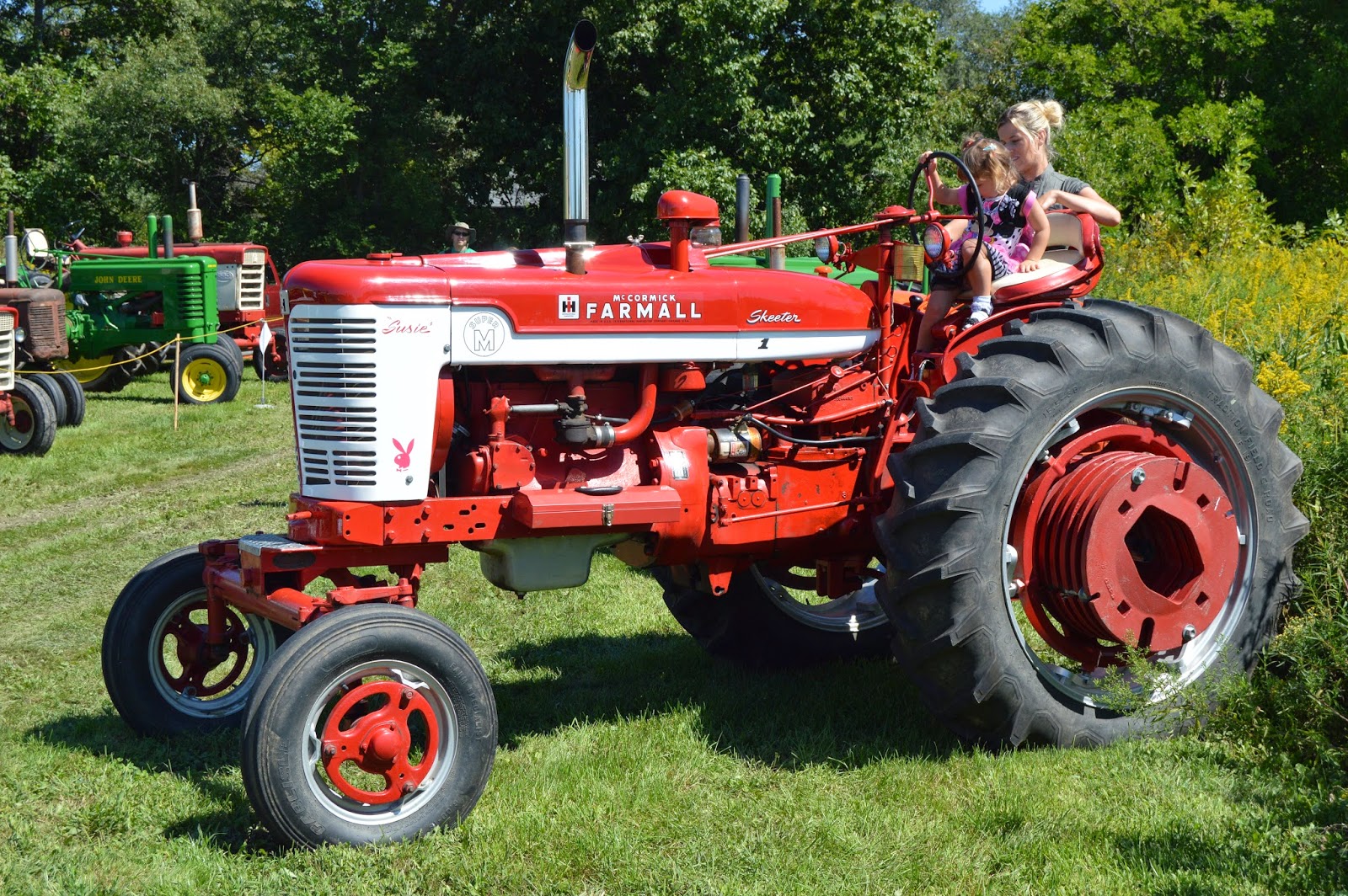


I think that is the first Farmall I have seen that has a row-crop front instead of a tricycle front. And I doubt if the bunny head was OEM. That is an impressive number of wheel weights mounted on the hub. If I remember correctly, I think each one is a hundred pounds because I was always amazed that my Grandpa could lift one by himself when they added the weights for plowing. I took a picture of the other side to see if it had weights. And to record the all important fact that this is a 1953 Super M. Note that it does not have as many weights on the right side. When a tractor pulled a plow, the right tire would be in the furrow that was left by the previous pass, and it would have good traction. But the left tire would be up on the hard, packed dirt that had not yet been plowed, and it would have trouble getting as good a grip. So the left tire would have more weight than the right tire. In this case it looks like 5 vs. 3 weights. I am more used to seeing 2 or 3 vs. 0 weights. I also note that it has the same small belt flywheel that was on the
H in Naperville. Since I know an M has more horsepower than an H, my theory that the belt pulley size reflects the horsepower of the tractor is wrong. Looking at the rear we see it has a swing drawbar and a PTO. But it does not have 3-point hitch or hydraulic circuits.
For reference, I include this 1968 JD 300 that does have a 3-point hitch. Last July I started a post on the history of 3-point hitches, so I'll have a lot more to say about them some day when I get back to that post. It also appears that the standard for PTO shields has changed. You will have to skip below to the Farmall 560 to see an example of a tractor that has a hydraulic circuit.
I could not find a date for the following WD-45 Allis-Chalmers.
Antique tractor collectors must also collect weights. Note in the first picture above that this tractor had 4 tire weights on the left tire as well. And this tractor has three front-end weights. The reason for the front-end weights was to prevent "wheelies." If the plow resisted being pulled, but the tires kept going forward because they retained traction due to the wheel weights, then the thing that "gave" is the front end would go up. So the front-end weights effectively increased the pulling power of the tractor by keeping the front end on the ground when the pulling got tough.

I circled back later when the WD-45 was "kid free" to take pictures of the rear. What struck me was that the steering wheel and seat are offset to the right. I'll have to keep an eye out for other WD-45s to see if this is the standard design. The engineers may have done that so that the transmission lever could go directly into the center of the transmission. I took a "high" picture to get a good look at all of the gauges etc. So it is not obvious if this design had a PTO. It does have a
hydraulic circuit, but it is single-acting.
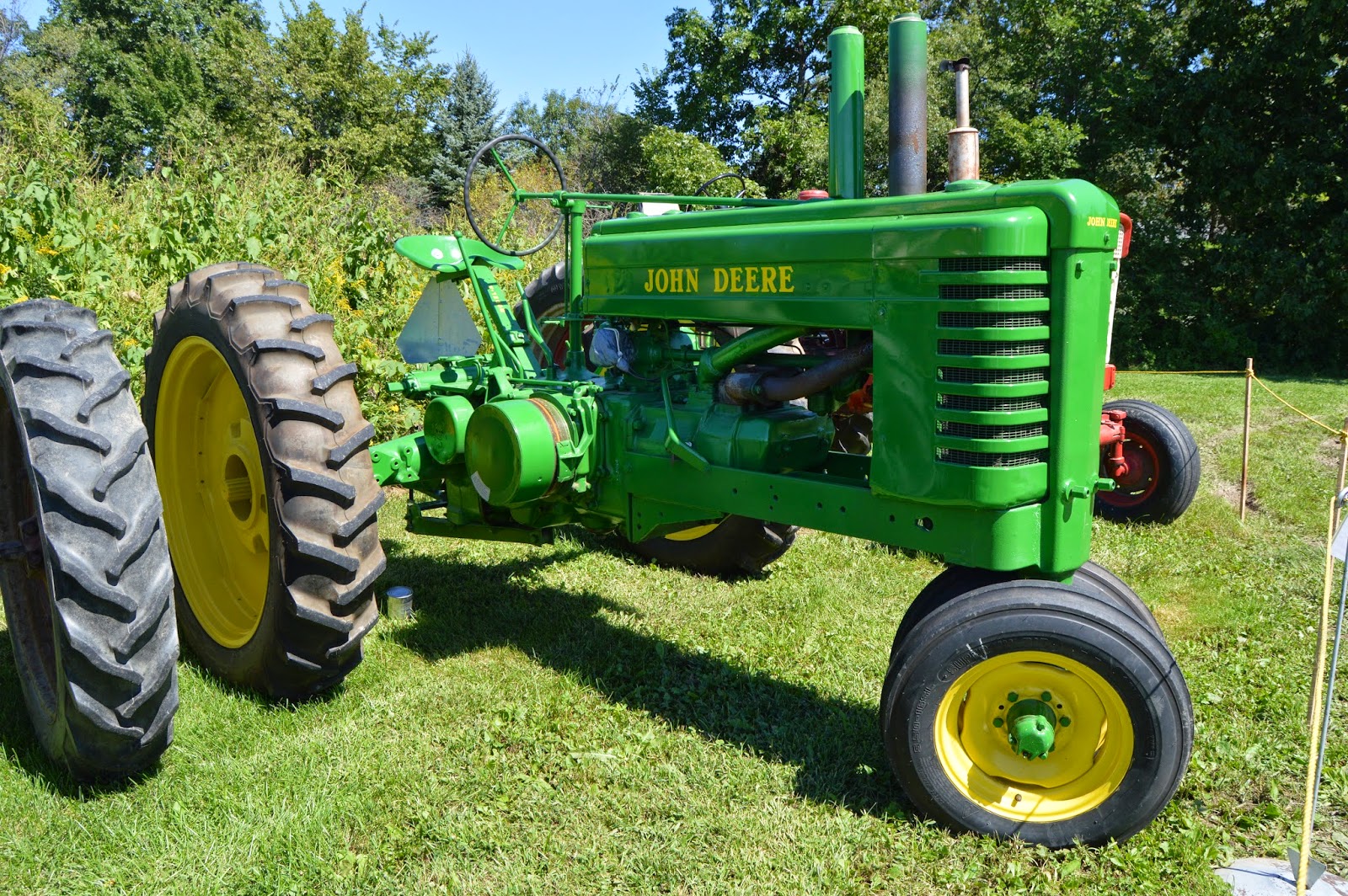
Next in line was a John Deere G, but I could not find a date.


It has a PTO and swinging drawbar, but no 3-point hitch. I don't know if it has hydraulics because I can't figure out what the gizmo above the PTO but below the seat is. If it is something to do with hydraulics, it does not have standard connections.
I finally have my very own picture of a John Deere putt-putt tractor. I zoomed in on the first picture above to get a view of the left side so that you can see the huge flywheel that a putt-putt needed because it had only two cylinders so the time between firings was long enough that you could distinctly hear each individual "putt". The big flywheel was needed to keep things going smoothly between "putts."
The show had a second putt-putt, and I got a better view of the left side.
Note how much air is in the "engine compartment." I believe the shaft you can see going across the middle drives the radiator fan. You did not have to worry about replacing the fan belt in these units. When I was zooming on the right-side view looking to see if it had turning brakes (discussed below), I noticed the model letter is on the seat post. Later, I noticed a sign that indicated this is a 1940 Model A.
You can see that this tractor was roped off and the rear was up against corn, so I was not able to get a shot of the back of these tractors. The show also had a model B putt-putt.
This Farmall 560 appears to be in original condition -- torn seat, a little rust on the bottom of the white trim, some dirt on the transmission case on the right side. But I think I prefer a realistic looking tractor to the typical gleaming restoration job. Note that this tractor is modern enough that it no longer has a belt pulley.


Since this tractor was on the end of the roped off area, I was able to get a partial view of the rear end. The PTO shield is missing, so you can see the shaft on to which the implement's shaft would slip. Above the PTO are the connectors for one double-acting hydraulic circuit. It also has some double-acting hydraulic cylinders connected to some sort of hitch mechanism. But it is not a standard 3-point hitch.

On the right is a zooming and brightening of the pedals on the right side of the tractor. You have to look closely, but there are two brake pedals, and a little lever that is flipped over from one so that it engages the other. That means the tractor is set up for road travel. If you push on either or both pedals, the brakes will be applied to both tractor wheels. For field work, you would flip the lever back into its own pedal so that it no longer engaged the other pedal. Then when you wanted to turn the tractor, you would not only turn the steering wheel, you would step on the appropriate brake pedal. In soft soil, especially with a tricycle front-end, just turning the steering wheel could be remarkably ineffective. The wheels would just plow a grove in the soil and the tractor would keep going straight. You quickly learned how to also apply the appropriate (side and amount) of braking power when you wanted to turn. When I was studying tractor manufactures last July, New Holland bragged about the "quick steer" feature. One thing it did was automatically use the brakes to help turn the tractor. Today's tractors are like today's camera, they use computers so it is now just point and go.

I do wish this tractor had a sign indicating the make, model, and year. I've never seen that arrangement for a steering wheel and shafts before.
And below is another International Harvester Co. tractor. (Farmall tractors are made by International Harvester.)
And the sign on the front of the tractor is:
In a different part of the farm, they had three more Farmalls. See the captions for details. And I now see that the mystery tractor above with the weird steering wheel arrangement is a Model C.
 |
| 1953 Farmall Super M |
 |
| 1949 Farmall H |
 |
| 1949 Farmall Super C |
And when I took the other side of the C, I included the old silos that were left on the farm.
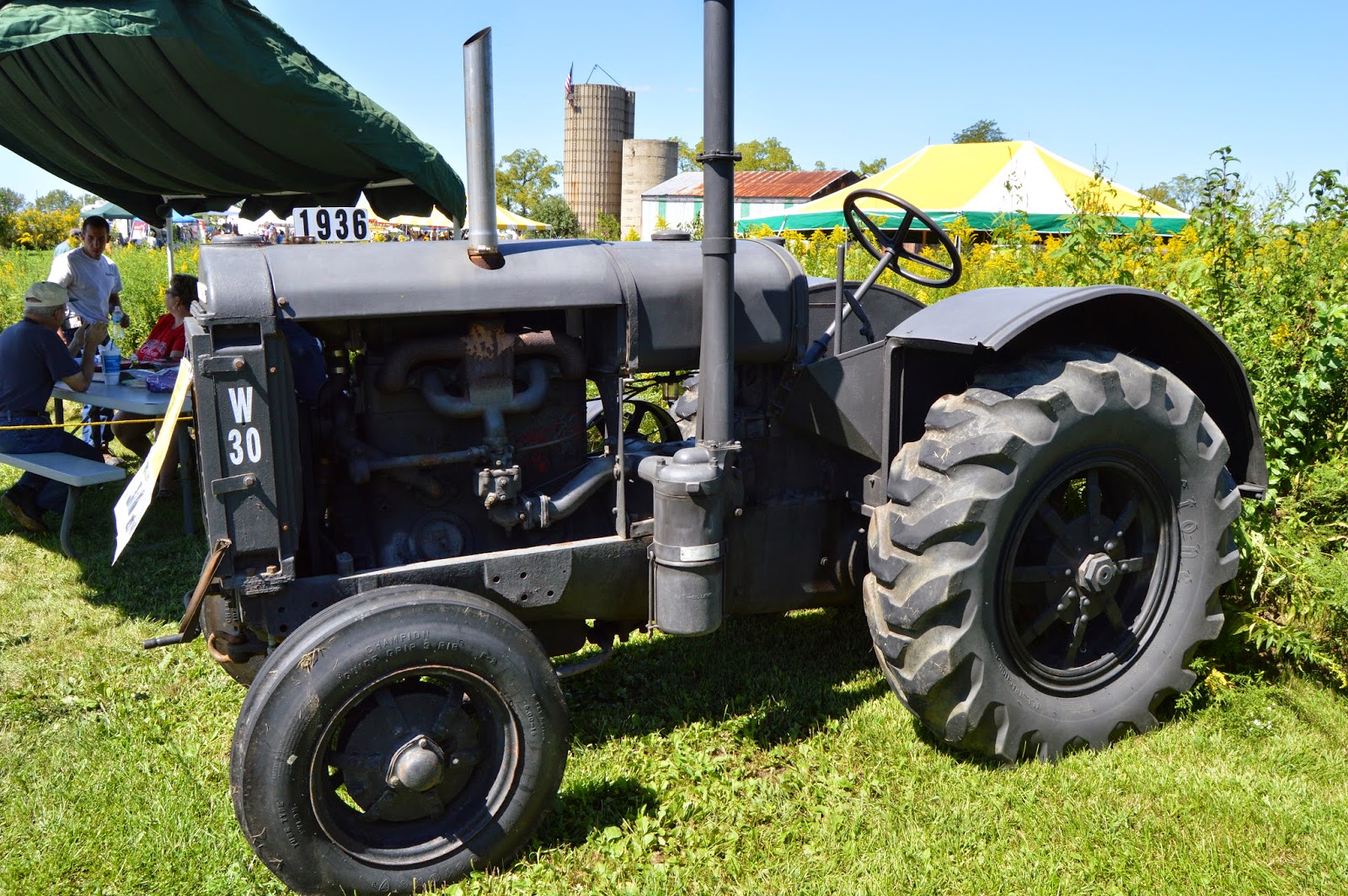
A 1930 McCormick-Deering 10-20


Another monument to wheel weights. I had a brain burp because I did not get a picture of the rear.