Little Feed Mill: (Satellite)
This feed mill was founded by some people that worked for Hale & Hunter to support a local pekin duck farm.
Zooming out, I found this poultry farm nearby.
 |
| Street View |
This feed mill was founded by some people that worked for Hale & Hunter to support a local pekin duck farm.
 |
| Bob Bowerman posted Ok, this one I just found. The "shacks" around the base of the stack are not how I remember that area looking like when I was just a very young toddler. The area was all brick. If I have my directions right I think "the lab" was just out of sight from the bottom right of the photo. bobb Michael Brandt: Bob Bowerman your correct about where the lab was and the Cafeteria isn't there yet. Bob Bowerman: Oh, man! That's awesome! I haven't revisited these childhood memories in decades! I mean I can remember the steam coming out of a vent in the bottom of the stack and I can still remember the sound of the whirling sound of the cables on the powershovels used to unload boxcars of bulk ingredients would snap taunt when the cluch popped and it reversed direction. They had steam shifters then as I remember. I think they shut the stack lid when they were close to entering the unload area and when they came out they open up the smoke stack a big cloud of sooty smoke followed by a blast of steam (white smoke) would shoot skyward. we little kids loved it. |
 |
| Michael Brandt commented on Bob's post the Laboratory still stands. [I looked for it on a satellite image, but I could not find it.] Bob Bowerman: Michael Brandt Your kidding! "The Lab" as my dad referenced it, was the nursery where the likes of Brick Meinert and Dr. Mike Kelly and you could probably throw my dad in the group, began their careers that went on to provide the science-based foundation that lead to the rise of Maple Leaf Farms (Maple Leaf Duck Farms) of little 'o Milford Indiana, as the largest producer of Pekin ducks in the western hemisphere. Brick was the "man in the duck house" observant, innovative. Dr. Kelly was out of Missouri hill country, he became MLF's nutritionist and was a pure numbers guy. His favorite saying was, "Figures don't lie, but liars always figure". This was usually said as he finished dismembering a feed ingredient salesman's presentation that was based on poor or purposely biased research. He just utterly despised phoo-phoo dust magical claims. My dad brought expertise in making pelleted duck feed that he acquired with his tour of duty at H& H to the table. I worked with all three of these guys and never heard a bad word about the "Hales Lab". All three were quality driven, science-based managers. I remember my dad coming home from work one day sometime after H & H had been bought out by a large (to remain unnamed) international grain company, in a very somber mood. (At the time MLF was the largest feed account for the H & H Mentone mill, which my father was manager) He and mom sat at the kitchen table with dad talking in a quiet tone about something going on at the mill. I remember my dad saying, "Bert Hales must be rolling in his grave, if he's seeing this". Not long after that my dad left H & H and went to MLF and supervised the building of it's own feed mill designed specifically for making duck feed. He always pushed quality and recognizing the frailty of man, stressed "it ain't a mistake until it goes out the door", as a way that encourage errors in production to be reported instead of covered up. He managed the MLF mill until he retired. The quality orientation and science-based production methods had had long roots reach back to "The Hales Lab". This probably more than you wanted to know, but I'm 70, this history shouldn't be forgotten when I die. bobb [Another photo of the lab] |
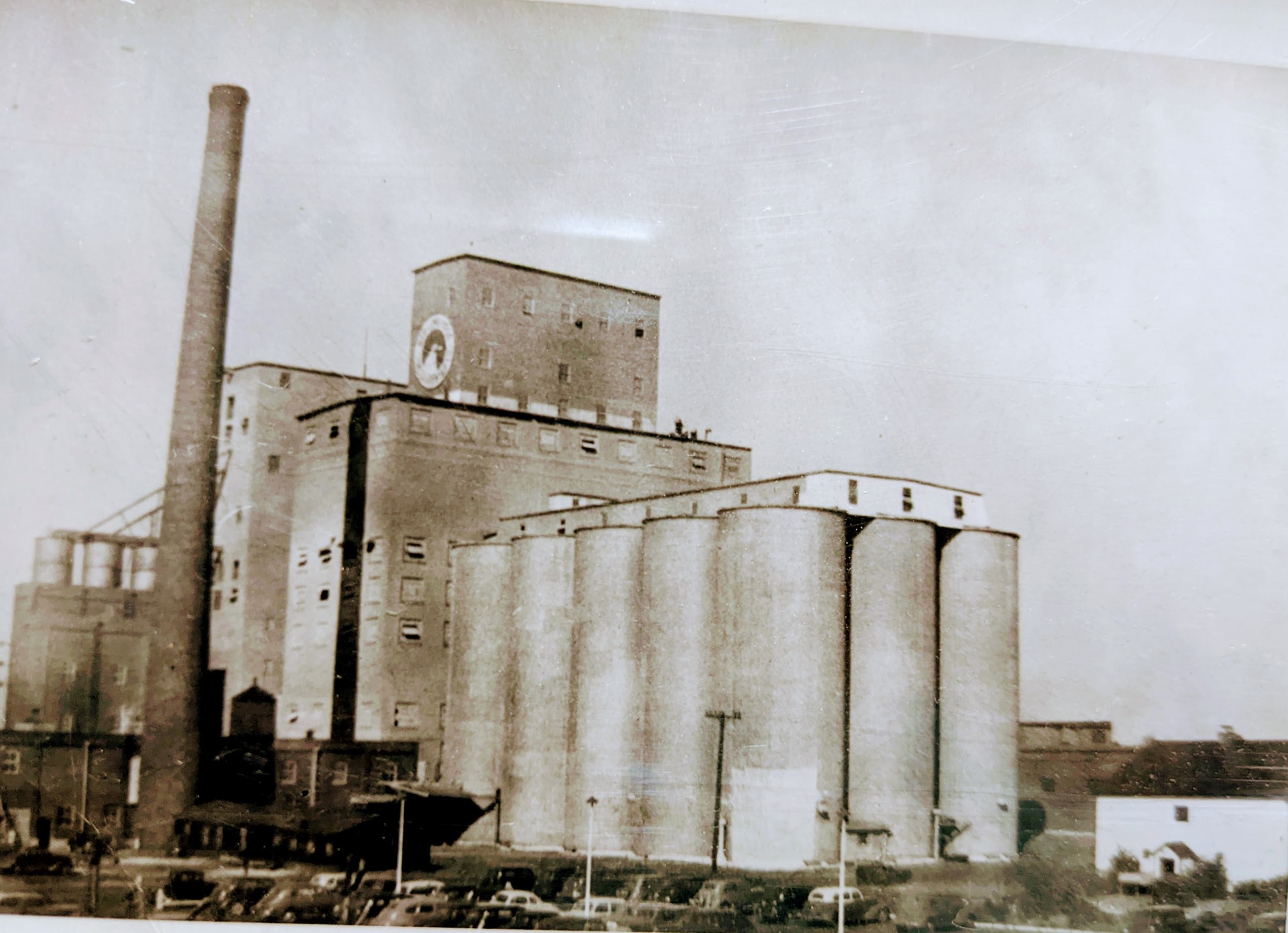 |
| Bob Bowerman posted Back to Riverdale! Very similar to earlier photo. This where you folks can add color commentary. I don't recognize a lot of this picture. I have no idea what the small white building to the right is. If you look close, there's two rr cars of coal at base of stack. I looked close at the white patch on the silo base. When I blew it up, it looked more like a concrete repair job, not white paint. From my experience it was either structural failure (not likely) or they had a silo fire. Silo fires at the bottom of a silo are indicative of poor housekeeping and/or poor ingredient rotation Getting the last of an ingredient out of a silo before refilling is labor intensive and not a lot of fun. Often this step is skipped and the bottom of the can gets older and older and starts to break down due to microbes feasting on the old/moldy bottom layer. Microbes give off metabolic heat and free moisture as they multiply. The additional free moisture speeds up the cycle dramatically. Temperatures go parabolic and certain areas begin to smolder. Fire department called and concrete wall is jack hammered open and pick and shovels are used to break clumps open and soaked down by firehose. bobb Michael Brandt: Bob Bowerman do you remember the chicken coops? They were in the area where the camera was pointing. But that white building is a mystery 🤔 |
 |
| Bob Bowerman posted This not in Chicago but Mentone Indiana. this is the mill I thought of as our second home. I made a few adjustments to make some things easier to see. I don't know what you know about operating feed mills but I'll walk you through this one; The mill is still under construction as there is no manlift in the back right side. The mill is brand new, not a single hammer mark on the silver bin bottoms. The guy smoking is probably the truck, bulk feed loadout person, down from his crows nest below the coned bulk feed bin bottoms and directly above the 80' truck scale. The guy in the suit is my dad. You never wear a suit in a mill...unless it's Grand Opening! The other guy is the mill super and the back guy is the pellet mill operator. In Chicago the pellet mills were up on the 2nd? floor. Pelleting feeds made the nutrients more bio-available and H&H ran hard on that fact. The got the duck feed biz because ducks hate eating mash. FCR (feed conversion ratio) improved dramatically when you switched to (H&H) pelleted feeds. This mill is like a HO gauge scale model next to Riverdale. bobb Brett Ellis: Is this the mill that became Cargill (Nutrena)?Bob Bowerman: yup. Brett Ellis: I shipped screenings to Fairbury in the late 70s. Bob Bowerman: Brett Ellis Always "weavil_free", right! 😉 I probably got pd from all the weevilcide I splashed on myself fighting those little buggers. Screening made excellent feed except it concentrated the mold toxins and grew wevils like crazy. Kurt Altmann: That’s craziness smoking in a mill !! Grain dust is a bomb. Bob Bowerman: Kurt Altmann It was just a different time back then. Kurt Altmann: Bob Bowerman Im thinking they different fire up the hammer mill new mill I worked at Acme Evens Flour Mill the mill started before Indiana was a state. Smoking and chewing tobacco was not aloud. You could smoke in the break room that’s it. We had a few roll fires scary times!!!!! Thunderstorm came one night and hit the roof blowing up the 8 floor on the wheat side it was like a bomb went off blowing out windows. Bob Bowerman: Kurt Altmann Acme Evens?? Hhmm, I used to buy midds/reddog from them. Out of the Chicago or was it Indy? And yes, flour mills figured out dust explosions way ahead of everybody. This doesn't work all the time but when it does it really impresses the little kids; Sometime when you are having a campfire with kids, you need the kind of fire an adult likes to make smore's over, not a kid. You need some flames, but not a roaring fire. Take a kitchen flour sifter, the old type with a mesh basket, fill it with some flour. Hold it above the flames and give the sift lever 1-3 quick pulls. If everything goes right (you need flames but not an updraft so strong the flour can't fall) the flour falls like a minifog cloud, the flames ignite the first particles and the density of the cloud of flour is such the ignition jumps to the particles nearby. Under ideal condition the flame front passes up through the flour dust cloud extremely fast, probably burning the hair on your wrist, each kid goes home with the intention of trying this out on their own. You are their hero. bobb |
Zooming out, I found this poultry farm nearby.
 |
| Satellite |
Big Boy 2006:
I missed this wood grain elevator until I saw this photo. It looks like they turned on the smoke for the rail fans.
 |
| Robby Gragg Flickr Mentone UP Big Boy 4014 leads the Coast to coast excursion East through Mentone, IN passing an old grain elevator. |
 |
| Street View, Jun 2023 |