|
| 3D Satellite |
CSX Transportation preparing to re-open hump at Radnor Yard in Nashville
 |
| CSX Locos posted GP40-2 at the roundhouse , Nashville Tn Jan 2025 |
 |
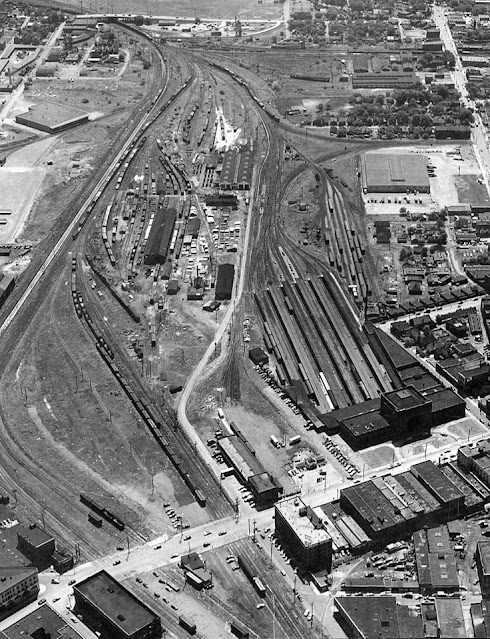
| Mike Ray posted Service center at Nashville Tn June 2025 Randall James: Former L&N Radnor yards & Roundhouse & 100' turntable, downtown can be seen in the background on the top left. |
 |
| CSX Corp from Trains |
"The hump was idled in July 2017 as part of the broad operational changes made by then-CEO E. Hunter Harrison, who converted eight of CSX’s 12 hump yards to flat-switching facilities last year....In 2016, Radnor was CSX’s third-busiest hump – behind only Waycross, Ga., and Selkirk, N.Y. — as it classified an average of 1,477 cars per day. That’s within the range that Harrison said was sufficient volume to justify the operating costs and capital expense of a hump yard....Radnor will be the second reversal of a hump closure at CSX. The hump was idled at Avon Yard outside Indianapolis in early August, then reopened by the end of the month as CSX experienced widespread congestion and service problems due to the rapid rollout of Harrison’s Precision Scheduled Railroading operating model." [Trains]
 |
| Cerita Sakura posted CSX Radnor Yard Nashville is a key hub in the CSX system, routing sixty trains per day through the Nashville Area toward five key cities: Atlanta, Birmingham, Chicago, Louisville, and Memphis. Forty of these trains simply pass through; the rest are “hubbed” in a classification yard. Radnor Yard, four miles south of downtown Nashville on the east side of the L&N main line south, was opened by the L&N in 1954, and can hold 7,905 cars. There are 13 receiving tracks and a 56-track classification yard, classifying 1,700 to 2,100 cars per day in 1998. The site covers 517 acres. CSX closed the hump-portion of its in 2017 as part of an operational shift led by then-CEO Hunter Harrison. Eight of CSX’s 12 hump yards were converted to flat-switching facilities before his death in December. CSX struggled to adapt its Nashville operations to Harrison’s flat-switching model. In 2018 the Radnor Yard hump was re-opened as flat-switching could not effectively handle the volume of traffic through the yard. Classification (hump) yards are a backbone of railroad operations. Individual carload traffic accounts for 60% to 70% of total rail traffic (excluding intermodal). Hump yards are massive facilities where trains are broken down and cars are sorted by pushing them over a hill. Gravity sending them down different to tracks by destination. Flat-switch yards move train cars using locomotive power, not gravity Viral Media posted a plagiarism of this info including the description. Viral Media posted again with their own description and credit for the diagram. CSX Radnor Yard |
CSX to reopen shuttered Nashville yard,
(I made the mistake of testing my copy of the link, and I exceeded a limit of 3 for 30 days.)
(posting)
Read this article beyond the obvious reopening of Radnor Yard.
Nashville seemed surprised that CSX wasn't immediately receptive to the idea of shutting down the core of their network operations and turning three of their main lines into commuter rail transit routes.
Maxwell Crosby That’s CSX for you.Nashville seemed surprised that CSX wasn't immediately receptive to the idea of shutting down the core of their network operations and turning three of their main lines into commuter rail transit routes.
Ted Gregory Agreed Maxwell.
I know they tried to close down a yard in Toledo (Stanley?) on at least two occasions and had to reopen it.
Mike Ray posted two photos with the comment: "CSX photos from the Radnor shop , Nashville Tn June 2024."
Patrick Cross: I spy ol’ crispy.
Philip Vieck: Patrick Cross what’s the story behind it
Patrick Cross: Philip Vieck fuel tank ruptured after derailing.
 |
| 1 |
 |
| 2 |
 |
| Doug Klink posted Just saw this South of Nashville. Looks like the roundhouse is still in use. John Sobaszko: L&N. Radnor Yard. Michael Sanders: Still very much in use... Radnor Yard is the largest "hump yard" east of the Mississippi River. Radnor Lake, nearby, was created by the L&N railroad in order to assure there was plenty of water available for their locomotives. Skipper L Swartout: Michael Sanders I thought Selkirk Yard was the largest in the east. Michael Sanders: Skipper, acreage wise you're correct. Capacity of cars though... Radnor can hold about 7900, while Selkirk is about 3500. I'm still out of date though on the hump yard status, as I was unaware that Radnor went to flat yard switching in 2017... |
 |
| Cerita Sakura posted CSX Railroad Hub Nashville is a key hub in the CSX system, routing sixty trains per day through the Nashville Area toward five key cities: Atlanta, Birmingham, Chicago, Louisville, and Memphis. Forty of these trains simply pass through; the rest are “hubbed” in a classification yard. Radnor Yard, four miles south of downtown Nashville on the east side of the L&N main line south, was opened by the L&N in 1954, and can hold 7,905 cars. There are 13 receiving tracks and a 56-track classification yard, classifying 1,700 to 2,100 cars per day in 1998. The site covers 517 acres. CSX closed the hump-portion of its in 2017 as part of an operational shift led by then-CEO Hunter Harrison. Eight of CSX’s 12 hump yards were converted to flat-switching facilities before his death in December. CSX struggled to adapt its Nashville operations to Harrison’s flat-switching model. In 2018 the Radnor Yard hump was re-opened as flat-switching could not effectively handle the volume of traffic through the yard. Classification (hump) yards are a backbone of railroad operations. Individual carload traffic accounts for 60% to 70% of total rail traffic (excluding intermodal). Hump yards are massive facilities where trains are broken down and cars are sorted by pushing them over a hill. Gravity sending them down different to tracks by destination. Flat-switch yards move train cars using locomotive power, not gravity. Louisville & Nashville Railroad Historical Society shared Edit: here's a link to the original content: Patrick Carroll: Stolen content. Belongs to the Railroad Journal/Robert Bender. |
%20Cerita%20Sakura%20-%20CSX%20Railroad%20Hub%20Nashville%20is%20a%20key%20hub%20in%20the%20CSX...%20_%20Fac.png) |
| Comments on Cerita's post |
%20Cerita%20Sakura%20-%20CSX%20Railroad%20Hub%20Nashville%20is%20a%20key%20hub%20in%20the%20CSX...%20_%20Fac.png) |
| Comments on Cerita's post |
 |
| Cerita Sakura posted CSX Nashville Hump Yard Nashville is a key hub in the CSX system, routing sixty trains per day through the Nashville Area toward five key cities: Atlanta, Birmingham, Chicago, Louisville, and Memphis. Forty of these trains simply pass through; the rest are “hubbed” in a classification yard. Radnor Yard, four miles south of downtown Nashville on the east side of the L&N main line south, was opened by the L&N in 1954, and can hold 7,905 cars. There are 13 receiving tracks and a 56-track classification yard, classifying 1,700 to 2,100 cars per day in 1998. The site covers 517 acres. CSX closed the hump-portion of its in 2017 as part of an operational shift led by then-CEO Hunter Harrison. Eight of CSX’s 12 hump yards were converted to flat-switching facilities before his death in December. CSX struggled to adapt its Nashville operations to Harrison's flat-switching model. In 2018 the Radnor Yard hump was re-opened as flat-switching could not effectively handle the volume of traffic through the yard. Classification (hump) yards are a backbone of railroad operations. Individual carload traffic accounts for 60% to 70% of total rail traffic (excluding intermodal). Hump yards are massive facilities where trains are broken down and cars are sorted by pushing them over a hill. Gravity sending them down different to tracks by destination. Flat-switch yards move train cars using locomotive power, not gravity. The yard uses Trainyard Tech, LLC CLASSMASTER™ hump yard process control system at CSX’s 56-classification-track Radnor Yard. The companies’ software is the first to apply standard industrial automation technology to the railway industry. [I hate repeating all of his "boilerplate" description, but he did add some new information at the end.] |
William Walker posted three photos with the comment: "What 2 hours at CSX Radnor Yard can get you if the mainlines are dry."
 |
| 1 |

 |
| 3 |
Viral Media posted three photos with the comment:
CSX Radnor YardNashville is a key hub in the CSX system, routing sixty trains per day through the Nashville Area toward five key cities: Atlanta, Birmingham, Chicago, Louisville, and Memphis. Forty of these trains simply pass through; the rest are “hubbed” in a classification yard.Radnor Yard, four miles south of downtown Nashville on the east side of the L&N main line south, was opened by the L&N in 1954, and can hold 7,905 cars. There are 13 receiving tracks and a 56-track classification yard, classifying 1,700 to 2,100 cars per day in 1998. The site covers 517 acres.CSX closed the hump-portion of its in 2017 as part of an operational shift led by then-CEO Hunter Harrison. Eight of CSX’s 12 hump yards were converted to flat-switching facilities before his death in December. CSX struggled to adapt its Nashville operations to Harrison’s flat-switching model. In 2018 the Radnor Yard hump was re-opened as flat-switching could not effectively handle the volume of traffic through the yard. Classification (hump) yards are a backbone of railroad operations. Individual carload traffic accounts for 60% to 70% of total rail traffic (excluding intermodal).Hump yards are massive facilities where trains are broken down and cars are sorted by pushing them over a hill. Gravity sending them down different to tracks by destination. Flat-switch yards move train cars using locomotive power, not gravity.
 |
| 1 |
 |
| 2 |
 |
| 3 |
Viral Media posted three photos with the comment:
Hump Yard “Pin Puller”CSX Radnor Yard “Pin Puller” who is not only “cutting” cars so they can roll down the hump, but also is an RCO operator (remote control) that is controlling the engine pushing the cars up the hump. A Pin Puller Scoreboard Display is at the end of the hump walkway that directs the Pin Puller on where to uncouple the cars.Assuming no hazardous material issues, the pin puller at the hump crest will probably allow only one (and in some cases two) loads to uncouple at a time. Multiple empties coupled together and destined for the same classification track would be allowed to remain coupled together as they roll down the hill and through the retarders. The number of “multiple empties coupled together,” depends on how the hump was designed and what the retarder technology is capable of handling. The maximum number is somewhere between three and five empty cars.Cars are being “cut” so they can roll down the hump and be directed by computer and sorted by destination in the classification yard. A radio tag on each car identifies it to the computer, which knows the cars destination, and weight. The system even tracks wind speed, and applies braking by squeezing the wheels in a “retarder” that regulates the car speed. This creates the sweeping [probably screeching] sound. The cars can’t exceed 4 mph to prevent damage when the cars roll into the line of other freight cars on the classification tracks. It works sort of like a post office sorting mail. Each classification track represents a destination. After the cars are sorted, they become outbound trains and continue on their journey.
 |
| 1 |
 |
| 2 |
 |
| 3 |
 |
| Viral Media posted “B” Tower This tower overlooks the retarder complex at CSX Radnor yard that controls the speed of freight cars rolling down the hump. Car speed is trimmed by main, intermediate, and group retarders to meet the 4 mph maximum coupling speed permitted at this yard. Hump yards are massive rail facilities where trains are broken down and cars are sorted by pushing them over a hill. Gravity sending them down different to tracks by destination. Radnor Yard, four miles south of downtown Nashville on the east side of the L&N main line south, was opened by the L&N in 1954, and can hold 7,905 cars. There are 13 receiving tracks and a 56-track classification yard, classifying 1,700 to 2,100 cars per day in 1998. The site covers 517 acres. |