Tuesday, March 10, 2020

Chicago, IL: Campbell Soup Company

(Satellite, California on the west side, 35th along the south and tracks on the east side)

A history and six images

Jeff Templin posted
The Campbell’s soup building near I-55 and California. My dad was a bricklayer. He helped build this.
[I moved to the western suburbs in 1973, and I remember seeing this plant from I-55.]
Michael Anglemire The complex of buildings ran from east of California to Maplewood along 35th.
Tyrone Davis I worked there till it closed 1988.
Pat JF The new plant is in Tennessee . Lower Wages.!
Larry Coleman They have another plant in Ohio too.I've loaded there several times.
Dennis DeBruler Larry Coleman The one in Napolean?
https://www.google.com/.../data=!3m1!1e3!4m5!3m4...
Phil Labagnara Delivered flour there 400 100# bags on the floor pick one up put it on the pallet all by myself.
Ron Alaska Phil Labagnara
I remember those days. Just about everything was a floor load. Nowadays it’s all palletized.
Phil Labagnara I was young & at the bottom of the list got every flour load then they started slip sheeting them unloaded in about an hour and had the rest of y day to myself.
[I don't know what "slip sheeting" is.]

Micahael Koveski posted
Campbell Soup Factory on 35th St
Thom Techman View from the Stevenson Expressway.
Tyrone Davis I worked there from the early 80s till the doors was closed in 1988 fun memories
Maria Clavijo Phil Labagnara it actually burned down it was a horrible fire the embers fell all the way to the nursing home on 27th and California...
Maria Clavijo Waldolf Ursine the Campbells soup building burned down to the ground in 1997.

Dale Roger posted
Do you remember seeing this iconic can towering above a huge soup processing plant in Chicago?  This Campbell's Soup plant was their largest producer of tomato soup and cream of mushroom soup.
It was an experiment in vertical manufacturing, where the tomatoes or mushrooms in this case were taken by elevator to the top floor processed then sent to the next floor for cooling, next floor for canning and labeling. Next floor for boxing and stacking on pallets. Next floor for dock loading to send to retail or to warehouse. The sanitation and purity of the process was part of the result of the vertical manufacturing. The top floors were kept secured away from the open doors of the loading and receiving docks. I remember truck loads of tomatoes ambling down I55 piled high with red ripe tomatoes destined for Campbell's soup. The buildings are long gone. But I still look to the south as I drive past and remember the big Campbell's soup can in the sky.
Clyde Cleinmark: Their mushroom farm was in West Chicago.
Larry Shackley: They grew a lot of mushrooms out in West Chicago back in the day. Students at the nearby Academy had to deal with the overwhelming smell.
Ed Budzyn: Thank you for sharing! What year was the photo taken?
Dale Roger
Author


1938 Aerial Photo from ILHAP

1953 Englewood Quadrangle @ 1:24,000
I also got the 1963 map to add I-57. It appears that Campbell did some extensive changes to their buildings.
1963 Englewood Quadrangle @ 1:24,000

Chuck Roth posted
Brighton Park back in the 90s
Ed caught the plant while the fire-protection water tower tank was still painted like a soup can.
Edward Kwiatkowski shared (Flickr option)
A westbound Amtrak passenger train, passes through Brighton Junction on a sunny but cold and windy winter day.Chicago Illinois. January 1988. (View facing north.)
Brandon McShane HEP-equipped Heritage coach in the years before the Horizon cars.
Dennis DeBruler Thanks for including the direction you were facing. I was thinking the Campbell Soup plant was south of this junction. You fixed a "brain burp" in my head. I always like seeing photos that have that "soup can" water tower in the background.

The plant was gone by August, 1997.
Ray Weart posted
At one time I worked a regular job on the Wisconsin Central in Chicago pulling #45's train out of CSXT Barr Yard. And nearly every day I'd see IC train GLME (Glenn Yard-Memphis) cross in front of us at Brighton Park. In August 1997 GLME is slowly heading north on the GM&O on her way to Memphis. GLME would get to the IC mainline at Bridgeport for the trip south. And keep in mind that Brighton Park was non-interlocked which meant the operator could signal two trains across the diamond at the same time. Even if your move "Had the blade" you still had to make a positive stop. Which allowed cool photos like this to be taken.

Andrew Urbanski posted five photos with the comment: "Looking for photos in and around the Chicago Campbells Soup factory, the photos posted I found on Google. Thank you!"
David Hersrud: The gate entrance was at 35 and rockwell.
Christopher Allen Howe: I think a couple of those are Doug Davidson photos.
1

2

3

4

5
[Brighton Park]


Monday, March 9, 2020

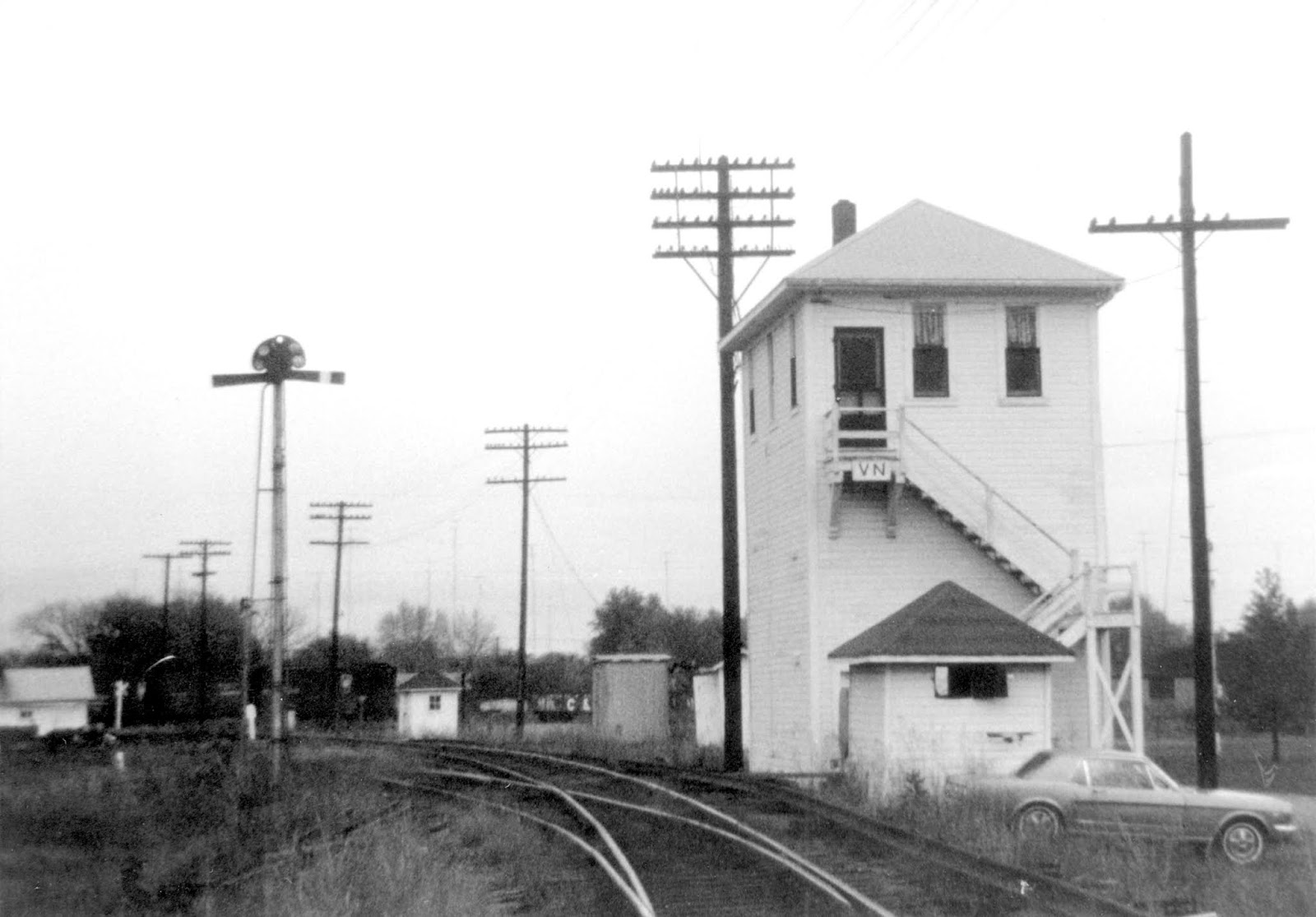
Mt. Vernon, IL: VN Tower: C&EI vs Southern and L&N

(Satellite)
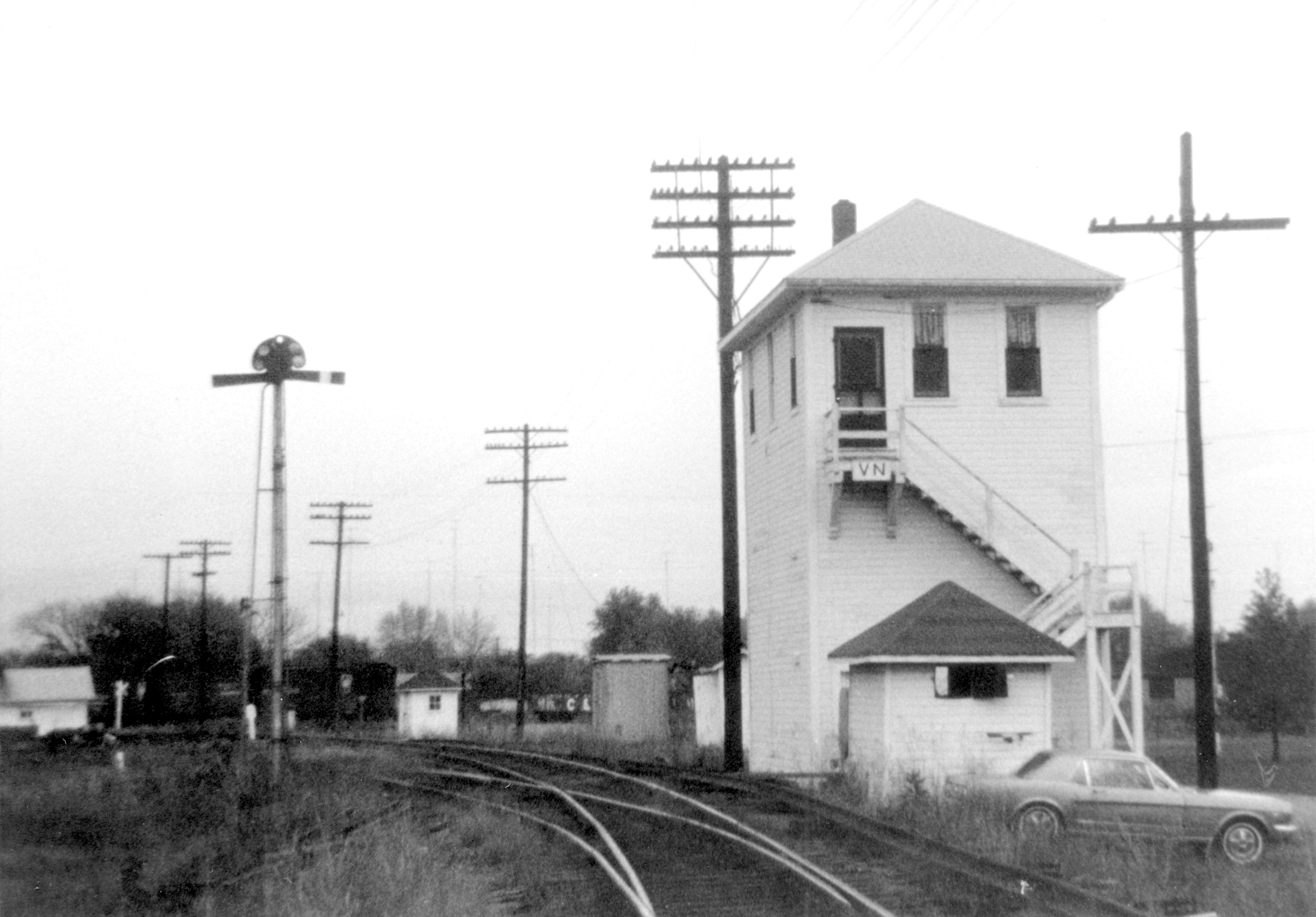
NorthAmericanInterlockings:   photo


Photo from Bill Grady Collection from Photo Archives from WestKentuckyNRHS

The tower was along the C&EI and a little closer to the L&N on the south than the Southern on the north. It is easy to find because of the shadow and because they have removed all of the coal mine buildings that were west of the C&EI.
1941 Aerial Photo from ILHAP

C&EIRHS posted two photos with the comment: "Looking south at VN tower in Mt. Vernon, IL. The L&N's Evansville-E. St. Louis line crossed the C&EI at VN tower and Southern's Louisville-E. St. Louis line crossed in the foreground on the east side of Mt. Vernon. Probably a John Barriger III photo."
1

2

C&EIRHS posted
VN tower at Mt. Vernon, Illinois.
[Flickr link via SouthernIllinoisRailroads
Flickr comment: "NRE now occupies the area in the background at right."]
 
Stephen N. Brannon posted
Train Order Boards out north and south at the  C&EI VN Tower, Mt. Vernon, Illinois where the C&EI Southern Illinois line crossed both the L&N and Southern mains to St. Louis.
Bob Johnson: This Tower burned down, but can't remember when. At that point the Train Order work was moved into the metal shed that they called the Yard Office. They built a desktop Interlocking board with toggle switches that faced the ceiling, that replaced the plant from the Tower. I was awarded an Extra Board job as Mt. Vernon Operator in early 1997, but never worked it. I broke in on the job 2 different days, but never worked it.
Richard Fiedler shared

I have separate notes concerning the coal mine.
Roger Kujawa posted
Mt. Vernon Illinois IL ~ Mount Vernon Coal Mine 1913. It looks like a railroad interlocking tower behind the coal mine seen through the legs.
David Cantrell VN Tower was built by C&EI in 1894. The tower in photo above must be the first one built at the location.
David Cantrell VN Tower photo by Bill Grady from West Kentucky Chapter of the National Railway Historical Society. This tower is more square than rectangular as the one in the photo above. http://westkentuckynrhs.org/.../Bill%20Grady.../BGC004.jpg

Roger Kujawa shared
Dennis DeBruler I believe that tower was along the C&EI between Southern and L&N. What was the name of that tower? Since the tower in the photo is on a slight angle, I think we are looking eastish with Southern on the left and L&N on the right.

Saturday, March 7, 2020

Birmingham, AL: Preserved?/Southern Finley Roundhouse

(HAERSatellite)

Photo from HAER ALA,37-BIRM,32--1 from al1068

AERIAL VIEW LOOKING NORTH, ACIPO PIPEWORKS IN BACKGROUND. - Finley Round House, Sixteenth Street, Birmingham, Jefferson County, AL

It was constructed in 1915 by Southern Railway with reinforce concrete. [BhamWiki] Remember that reinforced concrete would still be "bleeding edge" back then. And, as with coaling towers, that is probably why it is still standing. Reinforced concrete, if the contractor doesn't cheat and use too much sand, is strong and the demolition costs are high.

This page has a map that shows what Finley Yard used to look like before 1952 when Southern disassembled it and sold the land because Southern moved its operations to the Norris Yard in Irondale. [BhamWiki, rypn]

The backshop buildings to the west were sold to Farmers Market and American Cast Iron Pipe Company (ACIPCO).
1959 Birmingham North Quadrangle @ 1:24,000
Kaley Shaheen
It appears that APCIPCO expanded by moving north of the tracks and Mill Steel Company now uses some of the backshop buildings. (I noticed that I drive just a few blocks away from this roundhouse when I use I-65 to go to Florida.)
Satellite
The roundhouse was used as a cold storage warehouse. That is why there are truck loading doors on the roundhouse stalls, a newer rectangular building to the south, and a railroad spur on the east side. But that use has ended, and it is now abandoned. But it looks like the clerestory windows are strong enough that vandals haven't bothered to break them. I wonder if they are made with glass bricks.
Save the Finley Roundhouse
Update:
Flickr from Blog from Westly Martin comment on a post
[The blog has lots of interior shots.]
(new window, 1:12)


6:26 video, information starts at 0:40.  (source) The shop included a transfer table.


Friday, March 6, 2020

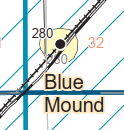
Macon C: Blue Mound, IL: Blue Mound Coal Co.

(Satellite?)

Roger Kujawa posted
1900s Coal Mining Postcard Blue Mound Coal Shaft Mine Macon County Illinois. This would have been served by the Wabash.

280 BLUE MOUND COAL CO. BLUE MOUND 1 SHAFT RP 1904-1913 SPRINGFIELD MACON 15N 1E 32 [Directory]

Map

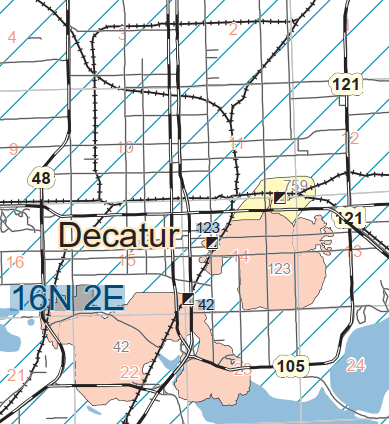
The problem when a mine closes in 1913 is that it is probably gone by the time the historical aerial photos were taken.
1941 Aerial Photo from ILHAP
There were bigger mines in Decatur.
Map

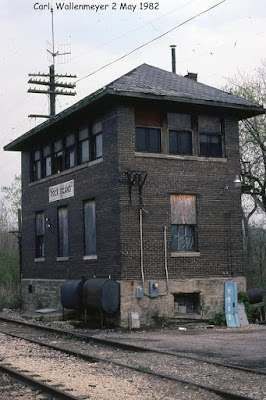
Joliet, IL: MC Tower: Rock Island vs. Michigan Central and Rock Island Engine House

(no CRJ; John Haynes Track DiagramSatellite, not only is the tower gone, the banks of the creek have moved)
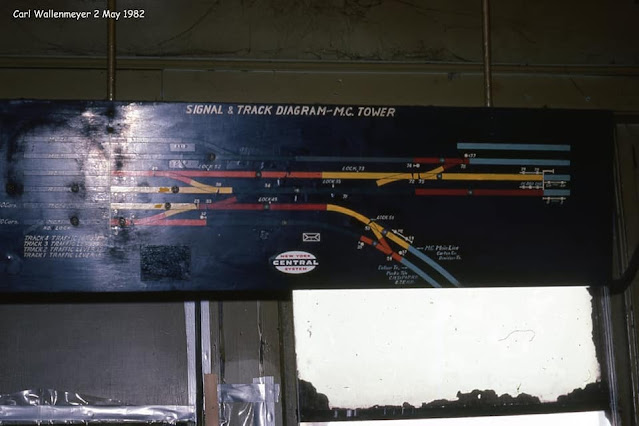
NorthAmericanInterlockings:  photo,  photo,  model board
Chicago and Northern Indiana Railroad Interlocking Towers (click the marker for the correct information)

Since I used to confuse the MC and JC (Rock Island) Towers, I show both of them on this topo map using a blue rectangle for MC and a red one for JC. The MC tower controlled where the MC joined the RI tracks for access to the Union Depot.
1954 Joliet Quadrangle @ 1:24,000

Using the same color convention, I mark the MC and JC towers on this historic aerial.
1939 Aerial Photo from ILHAP
Barriger

Mark Llanuza posted
It April 1984 a view of EJ&E & Rock Island tower at Joilet IL [Michigan Central tower] and old rock island shops
[Note the turntable to the right of the shops.]

Arron Oliver posted
Rode one of the Rockets from Ottawa to Chicago, most of the trip in a vestibule. Rock Island NW2 4901 (built 1947 as P&LE 8708), a GP7R and an E were caught with an Olympus Pen D half-frame 35mm camera while passing the engine house in Joliet, Illinois - June 12, 1977.
Richard Fiedler shared

A Dec 30, 2019, comment by Ed Brunner on the UD Tower notes [Google destroyed those notes] explains:
Rock Island Tower (on the EJ&E) was staffed by EJ&E employees. MC Tower (in between UD and RI) was staffed by Rock Island employees.
MC seems to have been originally a tower designed to direct the Michigan Central trains across the Rock Island tracks, using crossovers (rather than a crossing) that Rock Island trains could use to shift from eastbound to west bound tracks or vice versa.
In 1944-45, when CTC was installed from the RI double track Blue Island to Morris, the CTC board was installed at MC in two separate segments: Morris to Joliet and Joliet to Blue Island. When I worked in the tower briefly in 1978, the third shift was covered by an employee from the dispatcher's roster, the other shifts covered by train order clerks. The DS employee covered the job sequentially for several weeks with no down time, then was off for ten sequential rest days (I think it was ten but it could have been eight), and the job was then protected by a DS from the Des Moines office, which is how I showed up there, covering the regular guy's down time.

The Joliet Cutoff of the Michigan Central is now abandoned, but you can still see the bridge where it crossed Hickory Creek on the right side of this satellite image. See Bill Molony's posted photo below of NYC locomotives on this bridge. If you look further east on a modern map, you will find the Old Plank Road Trail. That was the right-of-way (RoW) of the MC.
Satellite

Brian Skrabutenas posted
Joel J. Sieracki Michigan Central's Joliet Cut-Off crossed the Rock here on a series of x-overs to get to their yard.

Brian Skrabutenas posted

Steven Holding posted
MC tower from the back porch of a GM&O SD-40 taking ballast to the RI JO yard job in the '70's
Richard Mead Yes, the Rock tracks needed a lot of ballast in the early 70s

Mark Llanuza posted

Bill Molony posted
New York Central Railroad F7A #1757 and Pennsylvania Railroad GP9 #7162 crossing Hickory Creek, just east of MC Tower on the Joliet Cutoff in June of 1968.

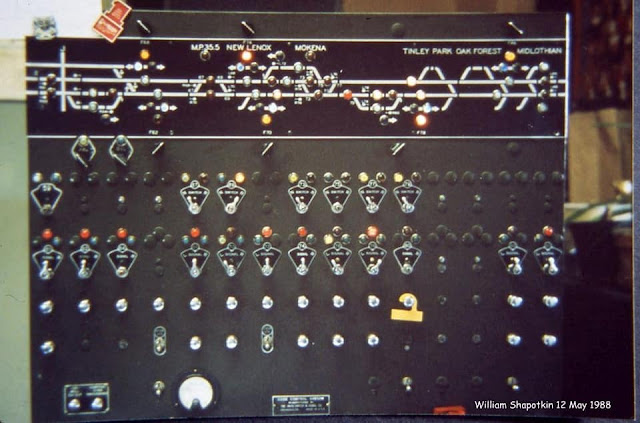
Darren Reynold posted eight photos with the comment: "NYCs   M.C. Tower   Joliet,ILL."
Gregg Gary: PRR & NYC sure gave their operators a lot of CTC to work with.
Bill Haines: Gregg Gary PRR operators had an agreement that only they (not dispatchers) could control interlockings. Hence the term CTC operator.
Tom Barnett: Somehow in the 1980’s, CR era, the carriers, primarily CR, got around that rule (maybe federal labor board decision?) where only operators, by Agreement, “owned the work” of hands on control of interlockings. The agreement was in the old ORT agreement book with the PRR but not in the NYC agreement book. With that Agreement requirement knocked down and out of the way, carriers were free to consolidate everything onto the train dispatcher’s desk after which it was bye bye local tower control rendering the position of operator and the operator’s craft redundant. Same with copying of and delivery of train orders. Operators once owned that particular function of railroading, ie form 19 and form 31’s. Carriers found a way around that rule. They simply went to track warrants, form D’s and other formats of radio block controls directly issued by dispatcher to locomotive engineer or conductor. Thus no need for the carriers to employ a middle man, an operator. I’ve still got copy of my old ORT -NYC lines west of Buffalo Agreement book circa 1951. Unbelievable high number of operator positions once required to handle the movement of trains and mann the local towers and depots.
Howard Swanson: This interlocking was located on the end of a Michigan Central (NYC) branch line from East Gary. At the time of these pictures, a single local served the line with much of the work at Chicago Heights. The branch line was operated under timetable and train order. The CTC panel appears to control the Rock Island through the southern suburbs of Chicago. I’m surprised that a NYC operator (Conrail at the time of the pictures) was responsible for Rock Island territory. I also assume that the interlocking at Joliet station was a Santa Fe job.
1

2

2

3

4
Gary Olden: Union S&S Interlocking Machine.

5

7
Howard Swanson: Is this the site of Metra’s Joliet Coach Yard?
[Steven's photos below identifies the building near the center as the engine house. Note the turntable to the left of the building.]

Dennis DeBruler commented on Howard's comment
No, this is located east of the yard. In this topo excerpt, the Metra yards are on the left side and the photo is looking at the right side of the map. Note the MC tracks joining the RI in the foreground and the turntable in the right background.
1954 Joliet Quadrangle @ 1:24,000

8
All images from North American interlocking website
Gary Olden: More intricate for higher traffic flow.
Andy Hughes: This route essentially run by operators (Chicago-Joliet) There was some kind of supervisor, but most or all decisions were left to operators.

Steven J. Brown posted
Rode one of the Rockets from Ottawa to Chicago, most of the trip in a vestibule. Rock Island NW2 4901 (built 1947 as P&LE 8708), a GP7R and an E were caught with an Olympus Pen D half-frame 35mm camera while passing the engine house in Joliet, Illinois - June 12, 1977.
Steven J. Brown shared

Steven commented on his post
A few seconds before: E6 630.