Wednesday, January 27, 2021

Buffalo, NY: 1899 National Steel/Hanna Furnace/Buffalo and Susquehanna Iron

(Satellite, on the south side of the canal built for this plant)

Note that if you click the thumbnails near the top of this history, you can scroll through larger images.

Steel Plant Museum of Western New York posted
This image is from the Hanna Furnace Corporation, see it on display in our exhibit "The Steel Crisis! The Decline of Buffalo's Steel Industry."
Just to clarify, Hanna Furnace only made pig iron and Donner-Hanna was a coke plant behind and half owned by Republic Steel.
They sold to many customers nationwide. One of their big local accounts was the Chevrolet Foundry in Tonawanda.
Hanna was on the south side of the Union Ship Canal, east northeast of Bethlehem Lackawanna. A park is there now.
Deborah Brown posted
Gary Walters: Don't forget Shanango Ingots at the end of the union ship canal.
Eugene Rigby: Gary Walters Shanango took hot iron from Hanna Furnace to make molds

Photo via hmdb
Established in the early 1900s and productive until its closing in 1982; Hanna Furnace was Buffalo's lucrative pig iron manufacturer employing 800 and producing over 3,000 tons of pig iron per day
The term "pig iron" arose from the old method of casting blast furnace iron into moulds arranged in sand beds such that they could be fed from a commin runner. The group of moulds resembled a litter of sucking pigs, the ingots being called "pigs" and the runner the "sow." Source http://www.pigiron.org.uk

The area before you was once packed with hundreds of proud workers in Buffalo's booming steel industry, an integral part of Western New York's industrial development. The city's many assets, including a strategic geographic location and strong labor force, positioned it as a major contributor to the economic growth of America. This growth would propel Buffalo's population to the 8th highest in the United States in 1910.

Geographically, Buffalo has no rivals. Access to the Great Lakes provided an unprecedented groundwork for marine-based commerce. The combination of marine, rail, and highway access created a unique transportation Paid Advertisement

Click on the ad for more information.
Please report objectionable advertising to the Editor.
hub ideal for the production, storage, and movement of goods. A cluster of companies would soon form along Lake Erie including Bethlehem Steel, the largest steel manufacturer in the U.S. from the 1930s until the 1970s.

Bathlehem Steel spurred the creation of many related industries including The Hanna Furnace Corporation, specializing in the process of steel production. Occupying nearly 70 acres of this site, Hanna Furnace stored an annual supply of 650,000 tons of iron ore, 150,000 tons of limestone, 350,000 tons of coke, employed 800 workers and produced 63,000 tons of pig iron per month at the peak of production during WWII.


James Brese posted, cropped
Hanna Furnace Corporation, Buffalo, NY, Dock Department.
Debbie Matthews: I always thought those blast furnaces were part of the Bethlehem Steel Lackawanna Plant.
James Torgeson
: Debbie Matthews The two plants were very close. There were another two blast furnaces at the Republic Steel plant on South Park, which wasn't too far away.

Bill bittner commented on his post
Hanna Furnace, Buffalo NY

Robert Hartloff posted
Hanna Furnace, Union Ship Canal, Buffalo, NY

James Torgeson commented on a post:
Hanna was a merchant iron plant that once had four blast furnaces. It shipped 10 and 35-pound pigs all over the country, by rail, truck and water. It also shipped hot metal to the adjacent Shenango Ingot Mold plant, and also to other area steel plants as the need arose. The pigs were also used in the trunks of employee cars during the winter!
James Torgeson posted
Here's a plant layout for Hanna Furnace in Buffalo, from the centerspread of an employee handbook, circa late 1950s, early 1960s.
I forget how many tons of pigs were removed from the Union Ship Canal when it was remediated a few years back!

Steel Plant Museum of Western New York updated
A nice graphic of one of the pig casters at Hanna Furnace. This handbook is from the late 1950s or early 1960s.

The park was built on the land that had the storage piles. I noticed in a satellite image, that the foundations and floors for some of the building still exist. So the cleanup is going slowly. One business that has moved into this area is the Hazmat Environmental Group.

1965 Buffalo SE Quadrangle @ 1:24,000

Bubba Dubs posted
Hanna Furnace, Buffalo New York date unknown. 

Mike Delaney posted seven images with the comment: "A series of photos of Hanna Furnaces Buffalo, New York.  Took Limestone in there once on a vessel.  I believe these were all merchant pig iron furnaces.  I know a friend of mine who sailed one of the Columbia crane boats took loads of pig iron ingots out of there."
1

2

3

4

5

6

7
 
Robert Hartloff posted
An amazing photo of the Hanna Furnaces on the Union Ship Canal North of and 90° from Bethlehem Steel in Lackawanna. Ships everywhere, extremely busy looking. This photo looks west on the ship canal, Hanna at left, Pennsylvania Railroad ore docks to right. The Lackawanna Steel plant (Bethlehem Steel) in background. Wish i could step into this. Unfortunately i do not know who took this or what year. If you go to the park that is here now, stand in that ladle and stare out and imagine this! The hills in the park are where the foundations from those blast furnaces are still burried ive been told.
Fred Bultman: Taken during winter layup.

Brian R. Wroblewski commented on Robert's post
What you were told is incorrect. The "hills" are meant to represent the raw materials piles on the old ore pit. The furnaces were (& still are) right behind them in the scrub area. You can still see one of their remains in this photo.

Brian R. Wroblewski commented on a comment
[Some comments talked about what Hanna made and Shenango. The summary is that Hanna made pig iron and Shenango used some of that iron to cast steel ingot molds.]

Antoniao Ignazio Medina posted
Susquehanna Furnaces, Rodgers-Brown Iron Co. Lackawanna,NY. 1933. This photo was taken from east window of Main Office building of Bethlehem Steel Company.
[Some comments indicated this was also known as Hanna Furnace.]
 

James Torgeson posted

Some pig casting action was featured on this Hanna Furnace Christmas card. Year unknown.
Digitally Zoomed
 
Michael Maitland commented on a post
Looking at pictures on line and found this ad

Robert Lackemeyer posted
A trip down to Tift St. caught Donner Hanna Furnace EMD SW-1 # 14, Buffalo, NY idling beautifully lit.   
James Torgeson shared
National Steel's Hanna Furnace in Buffalo closed in 1982.

Bill Hecht posted two photos.
Brian R. Wroblewski: Hanna Furnace, Union Ship Canal.
1

2

Bubba Dubs commented on Bill's post

James Cavanaugh Photography posted
From my Archive. A 1990 view of the former Hanna Furnace site adjacent to the Union Ship Canal. The site is now the Buffalo Lakeside Commerce Park.
Jim Cavanaugh shared with the same comment
Brian R. Wroblewski: The Rt. 5 "Bailey Bridges" are there in place of the recently torn down Father Baker before the new bridge was built. 

Buba Dubs shared seven photos.

Tuesday, January 26, 2021

Mountain View, CA: USS Macon Blimp in Hanger 1 of Moffett Field

(3D Satellite)

Goodyear has an even bigger airdock in Akron, OH.

Robert Bubba Blair posted (source)
I knew I had a pic of the Macon inside Hangar 1.
The Hangar is so large it will cloud up and rain inside!
There had to be a certain moisture content in the air and the sun would warm up the top of the hangar and condensation would occur... It was pretty cool.
Pam Milligan Vaughan: Capt. Wiley was the captain on both the Macon and the Akron. He was the man in charge in both the crashes of these two airships. He was later promoted to admiral. Go figure. His mom was a Gish and so was my grandmother. Cousins. Are the hangars still at Moffett Field?
Lynn Macey: The frame is still there but the exterior was removed a few years ago because PCBs were leaking into the ground water. Google has signed a 99 year lease and plans to re-cover the structure.

Lynn Macey commented on Pam's comment
The frame is still there but the exterior was removed a few years ago because PCBs were leaking into the ground water. Google has signed a 99 year lease and plans to re-cover the structure.

PlaneHistoria posted
1934 - Originally named Airbase Sunnyvale CAL. Now Moffett Federal Field. The USS Macon (ZRS-5) a rigid airship built and operated by the United States Navy for scouting and served as a "flying aircraft carrier," launching Curtiss F9C Sparrowhawk biplane fighters. In service for less than two years, in 1935 Macon was damaged in a storm and lost off California's Big Sur coast, though most of the crew were saved.
L.R. Wiley: My uncle was Vice Admiral Herbert Wiley. He served on each of the airships and survived each disaster. He went on to command the U.S.S. West Virginia at the battle of Surigao straight through the end of the war in Tokyo bay. They were a grand experiment with too few crew trained to handle unforeseen emergencies.
Jim Leslie: L.R. Wiley Your uncle was a VERY lucky man, especially surviving the loss of the USS Akron...I believe only 3 survived. In the case of the loss of the USS Macon, I think only 2 were lost. Still, that he survived both losses is remarkable.
The picture looks like it was taken in about 1935.
Matthias Miller: L.R. Wiley your uncle retired as a Rear Admiral.
Douglas Martin: L.R. Wiley yeah, it was probably your uncle that was threatening the pilot with court-martial if he did not put it on the deck of a pitching aircraft carrier..... the pilot did not want to do that...... your uncle was likely the cause in both accidents...... no wrecks....because he should have listened to the pilot and avoided the destruction. I met the pilot by the way.
Randall Hurst: L.R. Wiley airship crews trained on hot air free balloons before being assigned to dirigibles. The crew of the Shenandoah survived it breaking in half in a storm over Ohio by “flying” the intact rear section as a free balloon for hours until able to land it safely. The crew in the forward gondola fell to their deaths, however.
Chris Conlan: I live near moffett now, for many years the skin has been off the hanger. Just a large frame. It being restored now, scaffolding is everywhere.
Roger Smith: The Los Angeles was the only airship the Navy had that did not crash. It was built by the Zeppelin company in Germany after WW1. It was scrapped during WWII.
Dennis Kolb: There is also an existing dirigible building in Telluride Oregon. It is a museum. There were 2 the other used as a sawmill which later burped down.
Rick Timberman: Later, (early ww2) the navy added two more blimp hangers.I lived next door (about 1/4 mile away) in the '50s & ^60's. I can remember patrol blimps coming and going. Great air shows.
Steve Teetor: Rick Timberman One of the Goodyear hangers is in Pompano Air Park. I was getting my pilot's license there and they tried to recruit me, at least I was able to fly one. I was 17 and my plans were to go stunt, rotary, and commercial.
Douglas Martin: It was not just lost due to a storm..... the pilot was ordered to land it on the pitching deck of a carrier.... threatened with court-martial if he did not put it on the deck. His superiors apparently did not understand physics. How do I know..... I met the pilot at sun n fun in Lakeland. I was in charge of parking aircraft..... I had a long talk with him about what went down..... he was also the pilot of the second one that crashed..... the navy was doing their experiments..... he was ordered against his judgment to land on the deck of a pitching aircraft carrier. Then they had the gall to blaming him for the accidents instead of pinning it on the higher ups who were on board the carrier and threatened court-martial both times.
 
Robert E Duncan commented on PlaneHistoria
Moffett Field is mostly NASA now, called Federal Airfield, Hgr 1 has been on myth busters TV show a few times, all the military bases around San Francisco Bay closed a long time ago. I was a P3 flight Engineer a few years during the Cold War. Hgr 1 was a training command, Hgrs 2 & 3 were tactical VP squadrons. After someone flew a P3 through Hgr 1 the doors at one end were welded shut.
David Sliwa: Robert An unpiloted F8 crusader flew through Hanger 1, not a P-3.


Airships

This blimp, and its sister blimp USS Akron, could launch and retrieve airplanes for scouting. Note the brackets on top of the three airplanes below. That is what hooked to a bracket hanging from under the blimp. There is much more information on both the Airships and MontereyBay web pages.
MontereyBay
Three Sparrowhawks fly above Moffett Field located in undeveloped Sunnyvale, California.
Credit: Moffett Field Historical Society

Monday, January 25, 2021

1828 Carrick [Blast] Furnace near Metal, PA

(Satellite)

Tamara Bair Adams posted eight photos with the comment: "The Carrick Furnace in Metal , Pa. located along rt. 75 four miles south of Fannettsburg, Pa. was deeded to the Path Valley Historical Society in Feb. of 2020. The PVHS started in the Spring with removing years of overgrown brush and weeds, etc. the clean up is still ongoing. The Carrick Furnace is listed on the National Historic Registry of Historic places. The original Weimer blowing Engine and boilers are still intact .The Carrick Furnace is only 15 minutes off of the Pa. Turnpike Willow Hill exit, and 10 minutes, north of Rt. 30 on rt. 75 n."
[That recent cleanup explains why the satellite image shows just a bunch of trees.]
Tamara Bair Adams: Doug Plance The Mt. Pleasant Furnace was in Richmond Furnace, that’s the name of the Village where it is located, I think it might of been called Mt. Pleasant in the earlier days..I don’t know if their are any remains there or not, I could check into that....the photo’s I shared are the Carrick Furnace, which is only a few miles further North on the same road..a lot of people say the Carrick Furnace is at Richmond Furnace, I think just because they are so close, gets confusing...

James Torgeson shared

1

2

3
[According to the plaque in photo 7, "The Peter L. Weimer blowing engine is the only one extant in Pa, and apparently the only one know to be in existence nationally."]

4
[I think this was the boiler that supplied steam for the blowing engine.]

5

6

7

8

Carrick Furnace is a historic iron furnace located at Metal Township in Franklin County, Pennsylvania. The property includes the limestone furnace stack, a Peter L. Weimer blowing engine (1879), boilers for the steam engine, and the charging ramp, engine house, and cast house foundations. The furnace was built about 1828, and measures 30 feet square at the base and 30 feet high. Furnace operations were suspended in 1837, the property sold in 1843, then leased in 1850 to "Witherow and Walker." [PlaceAndSee]
The operations being suspended in 1837 is another reminder of the Panic of 1837.

Facebook Reel


Sunday, January 24, 2021

Duluth, MN: Hibbard Renewable Energy Center (REC)

(Satellite)

While looking at photos of the Bong Bridge, I noticed a smokestack the background. Any tall smokestack still standing in the 21st Century is Industrial History of some sort. 

The power plant became operational in 1931 and burned residual fuel oil. [EnergyJustice]

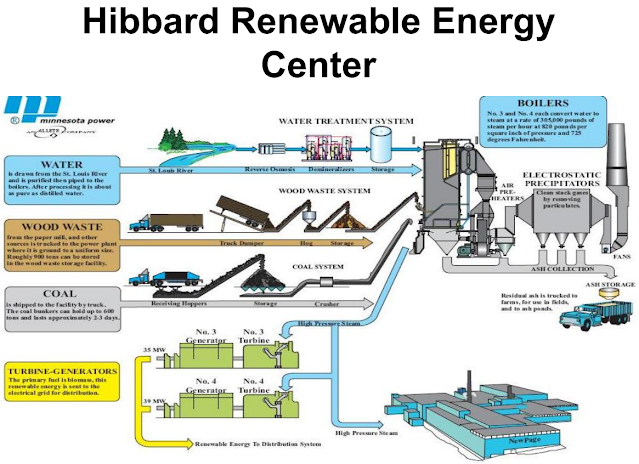
Units #3 and #4 were added in 1947 and 1951, respectively. Unit #3 now has a capacity of 35 MW, and #4 is capable of 39 MW; so this is a small plant of only 74 MW. It was closed in 1982 "due to economic downturn and rising production costs." It was started up again in 1987 to burn wood with coal to provide process steam to the nearby paper mill. (You can tell that the paper industry is struggling because I've seen three names for the mill: Lake Superior Paper Industries, New Page and Verso Duluth Paper Mill.) In 2009, Minnesota Power bought units #3 and #4 from the City of Duluth for $2.5m with the intention of investing 20m to increase the plants capacity so that the percentage of electricity generated from renewable energy would be higher. It is not clear why the city owned the plant until 2009. This expansion was expected to produce 210 GWH annually from mostly wood waste. [HeatingTheMidwest, DuluthNewsTribune

Kris Spenningsby of Minnesota Power [HeatingTheMidwest, p1]

The two upgraded boilers can burn wood, coal and/or gas. But this satellite image indicates that they really do burn wood waste. In fact, the mix is a 10/90 coal to biomass ratio. The narrow beige building on the right stores the biomass. We can see that the plant is operational because there is a truck being dumped at the bottom of the image. (Typically, satellite images are just a few years old. [EnergyJustice
3D Satellite

The stack is 331' tall. [pca, p5] 

MNpower

Most of the waste comes from forestry operations within 100 miles of Duluth. But in 2016 the plant burned about 9,000 tons of storm debris created by a July 21 storm. And they anticipated burning storm debris from an extended area for another 6-12 months. [MNpower Hibbard also burns the bark from the adjacent paper mill saving them the cost of disposing of waste. The bark and storm debris is cheap. But in general, biomass has become expensive because of increased competition for the waste. The building stores 900 tons, but the plant burns over 1,000 tons a day. (Unlike coal, biomass must be kept dry.) So a continuous 7-day/week parade of trucks is needed to supply the wood waste. But they can switch to burning just coal if their biomass supply is interrupted. One advantage of consuming incoming waste within 24 hours is that they don't have to worry about it growing some mold. Mold causes the waste to cake which can reduce the flow of the fuel to the boiler. The quick consumption also reduces the risk of spontaneous combustion. In contrast to moist conditions creating mold, dust is also an issue. All of the wood handling is done inside negative pressure enclosures and the air sucked out of the enclosures is run through a filter in a baghouse. And they grind the waste on site so that the trucks are hauling material with a larger size. Furthermore, there are problems burning wood in a boiler that was designed to burn coal. One is "sparklers." It sounds like these are glowing embers that didn't get totally consumed in the combustion chamber and that can cause fires in the particulate removal equipment. (Boilers that are installed in paper mills to burn their wood waste have a different design and can burn waste that has been stored in the rain and snow.) [BiomassMagazine via EnergyJustice (The City of Duluth still owns 50% of the plant.); pca]

HeatingTheMidwest, p5
[Remember, you can click the image, then right-click it to save it disk, then zoom and pan it with your favorite photo viewer.]

Hibbard produces steam for the paper mill 24 hours a day. This keeps the boilers hot so that Hibbard can be used as a peaking plant. Other renewable sources such as solar and wind can't control when they generate power, but wood can generate power when it is needed, and when the wholesale rates are highest. [MNpower

I read this article before I read some of the others referenced above. I was left with the impression that the $100m upgrade was effectively a public relations stunt to increase the renewable energy percentage that Minnesota Power could claim. But that, in practice, the plant is generating very little electricity. So the ratepayers are having to suffer the burden of the $100m capital cost.

But the article seems to assume that the electricity generated by a power plant would go to the grid. Specifically, it assumes that "rarely dispatched by MISO" means "rarely generating power." But "The Duluth facility typically generates about 50 MW from a 10-90 coal to biomass ratio." [BiomassMagazine] And:
EnergyJustice, unfortunately, the "red text link" is broken.

So Minnesota Power does not want to provide electricity to the grid with this plant because it has already sold the power, not because they don't want to run it! Not only that, it is selling steam. So it has two streams of revenue, and it is helping the ratepayer by paying off the capital cost itself. What is even more disconcerting is the mistake of not distinguishing between generating power and suplying the grid by the Public Utilities Commission, not the author. It is the job of the PUC to understand that contracted electricity and steam helps the ratepayer! (I seldom use exclamation marks. But I see this is a two "bang" paragraph.)


Friday, January 22, 2021

Evansville, IN: Union Track Junction and the 1.5 Mile Union Track

(Satellite)

C&EIRHS shared
Union Track was a jointly owned 1.5 mile connection between the C&EI rails at milepost 285.8 to the Louisville & Nashville tracks at Union Station on Fulton Avenue. Part of the Union Track ran down the middle of Division Street as shown in the photo.
It appears the western end of Union track still exists to provide plastic pellets to Barry Global.
Chicago & Eastern Illinois Railroad Historical Society: Dennis DeBruler It does.
Dennis DeBruler: Chicago & Eastern Illinois Railroad Historical Society https://www.google.com/.../data=!3m6!1e1!3m4!1s8cIIt...

It appears Division Street used to be called Pennsylvania Street. Note the little black lines in Pennsylvania Street. That indicates street running tracks.
1957 Evansville South Quadrangle @ 1:24,000
My 2005 SPV Map labels the eastern terminus of Union Track as Union Track Junction. I noticed that Southern terminates here and joins the C&EI tracks to the old depot. And then later Southern could use the C&EI tracks to get to Union Track. Did Southern used to share the C&EI depot? And then they also moved to Union Station in July 1935?