(Satellite, based on the aerial photo below.)
 |
| Chris Johnson posted North Cairo IL depot interior, 11/30/36. Larry Candilas: Would this be what is officially called Cairo Junction? Chris Johnson: Larry Candilas Probably so |
 |
| Mike Sypult posted North Cairo, Illinois on the IC. Clyde L. Anderson photo. Undated. |
Illinois Central Railroad Scrapbook And Occasionally Other Railroads posted two photos with the comment:
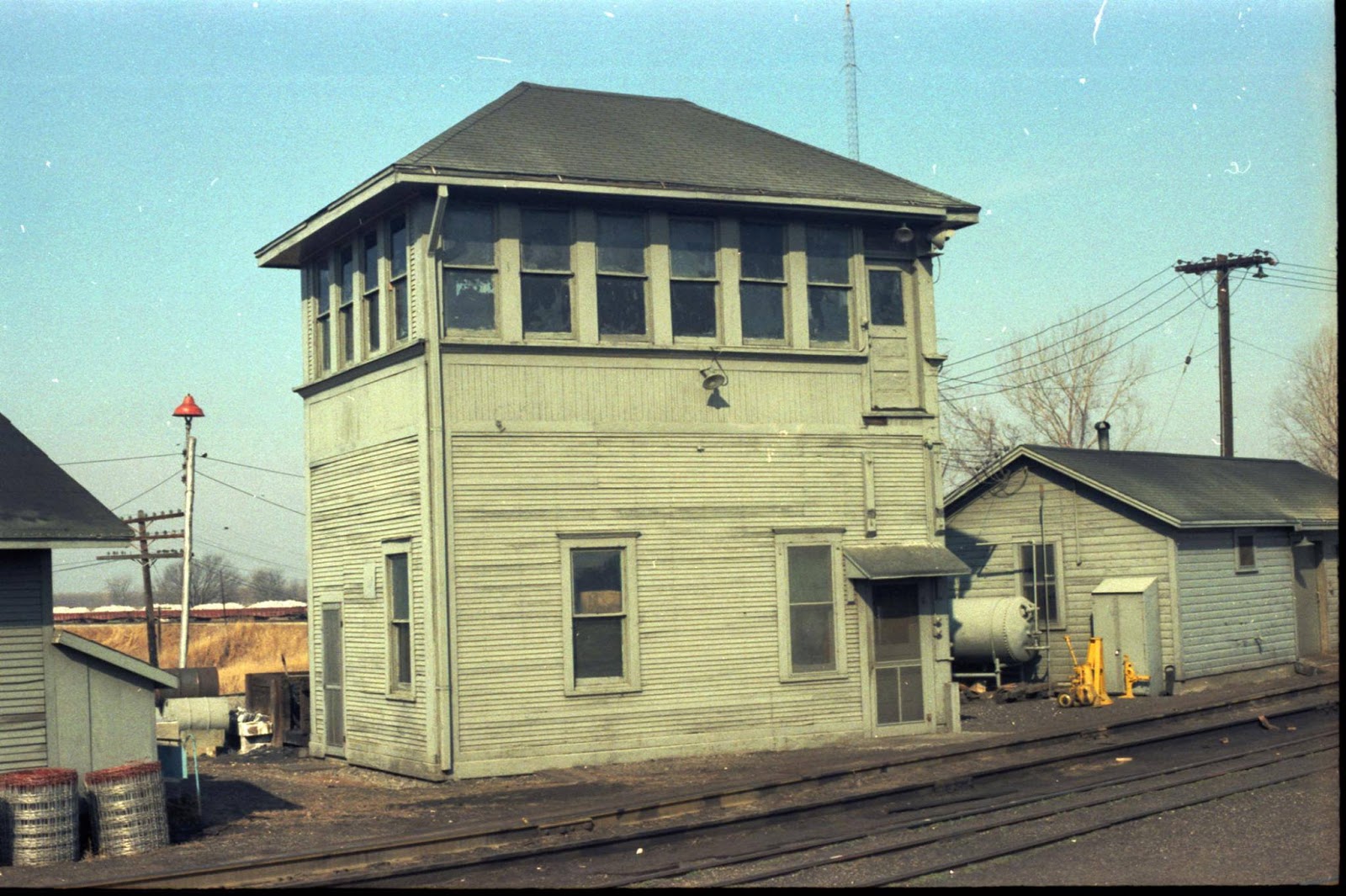
Two views of the interlocking tower at Cairo Junction, Illinois. Located about 3 miles north of downtown Cairo, the tower protected the junction between Illinois Central's north-south mainline and Mobile & Ohio Railroad's line from St. Louis (the M&O had trackage rights across IC's Ohio River bridge; on the south side of the river, the M&O joined the IC at Winford Junction, KY).Cairo Junction also was the location where IC's line into the city of Cairo itself joined the mainline.The tower seen here was built in 1902. According to an article in the June 6, 1902 "Railway Age", the tower controlled 15 turnouts (a.k.a. "track switches"), 14 signals, and 1 movable point frog. This was an electric interlocking plant. In other words, when an operator turned a lever, a signal was sent to an electrical motor connected to the turnout or signal, causing that device to move.The signal equipment was supplied by Taylor Signal Company.Apparently IC was not happy with this equipment. The December 24, 1909 issue of Railway Age Gazette says the old equipment was replaced by new signal equipment supplied by General Railway Supply. The old building was kept, however.The tower had a short life. Disastrous floods hit the Mississippi River in 1912, and the Ohio River in 1913. The city of Cairo itself was spared thanks to several miles of levees and a downtown floodwall. But IC's track north of town was heavily damaged. In response, several miles of track were raised between Cairo and Villa Ridge. The tracks at Cairo Junction were raised about 5 feet, necessitating the construction of a new interlocking tower.Both photos, IC photographer, Cliff Downey coll.
Shapley Hunter IV: The line from St. Louis was originally built in 1875 by the Cairo & St. Louis Railroad which, despite the name, never made it all the way to Cairo because they could not get right-of-way permission to cross Washington Street (despite the street not actually existing except on paper at the time). They had to negotiate an agreement with Illinois Central to use IC's tracks to enter the city itself. It also did not make it all the way to St. Louis, but stopped in Illinois. Originally a narrow-gauge railroad, the gauge was broadened after it was acquired by the Mobile & Ohio Railroad in 1886.
The Cairo & St. Louis Railroad initially stopped in Union County, as Alexander County and the City of Jonesboro were unwilling to allocate funds for the project through their jurisdictions.
The line nearly went bankrupt in 1877 when the Kaolin Tunnel, near the community of Kaolin, in Union County, collapsed. The Railroad reorganized as the St. Louis & Cairo Railroad in 1881. Kaolin was a mining town in which Kaolin, or China Clay, was mined and shipped to St. Louis.
Richard Fiedler shared
 |
| 1 |
 |
| 2 Jon Roma: There's a lot going on in this photo. From left to right: The stove door is wide open, and there are a couple lumps of coal on the tower's floor. The interlocking machine lacks a cover. Above the window at left is the model board; unfortunately, the track layout isn't visible. I see the ammeter and voltmeter to the right and below the model board on the left wall. At right background, I see someone's lunch basket. There's a CB&Q calendar on the right wall, and below it is a salt shaker. At near right, I see the three handles used to operate the three train order signals depicted in the exterior scene. There are three telegraph keys and a couple of sounders on the desk at right, but I don't see where they're wired in. There's more telegraph equipment on the leverman's desk. The blurred person who sits front and center is left-handed but doesn't look old enough to work for the railroad, though I could be wrong. Though I have seen this image before, it's one I never grow tired of. |
 |
| Stephen N. Brannon posted North Cairo, Illinois Tower. Junction of IC north-south main with GM&O St. Louis-Mobile main. Photo looks northward, IC on the right and GM&O branching off to the left. GM&O used IC bridge across Ohio River to Kentucky, then with joint double track a few miles south to Winford Jct. where GM&O split off on its own rails. |
 |
| Tommy Sowell posted Dad doing his thang. This was one of the motors ,that ended up being used for some merger advertisement pics. Jimmy Smallwood I remember one day we were standing out in front of the callers office and you dad had his grip setting on the ground there and Glen McCullar came up in his vehicle and ran over it. John P. Kohlberg posted a copy of Clyde's photo above pointing out that the rip-rap cars above look similar to the rip-rap cars in the background to the left of the Cairo Tower. |
 |
| John P. Kohilbert commented on Tommy's posting. [Note the GM&O marking. They had some yard tracks along the river back then. I wonder if these cars are kept here on standby in case they need to do any emergency repairs of a washout somewhere in Southern Illinois.] |
 |
| 1938 Aerial Photo from ILHAP |
The GM&O is down to just one track along the river and it looks like it is used for storage.
CN must use the M&O tracks into Cairo for storage because the satellite image caught them with a lot of covered hoppers on the track even though its route to Bunge is now broken. But since both the M&O and the IC routes are now owned by CN, they could easily pull that string north and then shove it over the wyes to the former IC track that still serves the Bunge plant.
 |
| Satellite |
 |
| Satellite |

No comments:
Post a Comment