The North Portal of the Howard Street Tunnel is just south of the train shed.
 |
| Street View, Jun 2011 |
 |
| William Niermann posted The Baltimore and Ohio Railroad’s majestic Mount Royal Station in Baltimore during the 1930’s-1940’s era when passenger trains were still very dominant. Behind the station is the very long train shed. Both the station and the train shed survive to this day. The station is now used by the Maryland Institute College of Art. Rail traffic is still quite heavy as this is the main route for CSX freight trains through Baltimore. The tunnels are currently [Aug 2025] being upgraded to allow clearance for larger freight cars. Thomas Dunne shared |
 |
| B&O Railroad Museum posted Located at the north end of the Howard Street Tunnel, the Mount Royal Station and Trainshed was the B&Os third station in Baltimore. The station opened on Sept. 1, 1896 and served the B&O's famed Royal Blue Line which ran the track between Washington, DC and New York City. Located only a few blocks from Baltimore's Penn Station, which now services the Amtrak service to Baltimore, Mt. Royal Station allowed for easy passenger service transfers between rail companies. When it closed in 1961, the Maryland Institute College of Art (MICA) took over the building and preserved its original architectural features. The building is now used for art studios by the college and there is a city light rail stop near the station. Baltimore & Ohio's Mount Royal Station as it appeared in the 1960s. Jack E. Boucher photo. Randall Hampton shared |
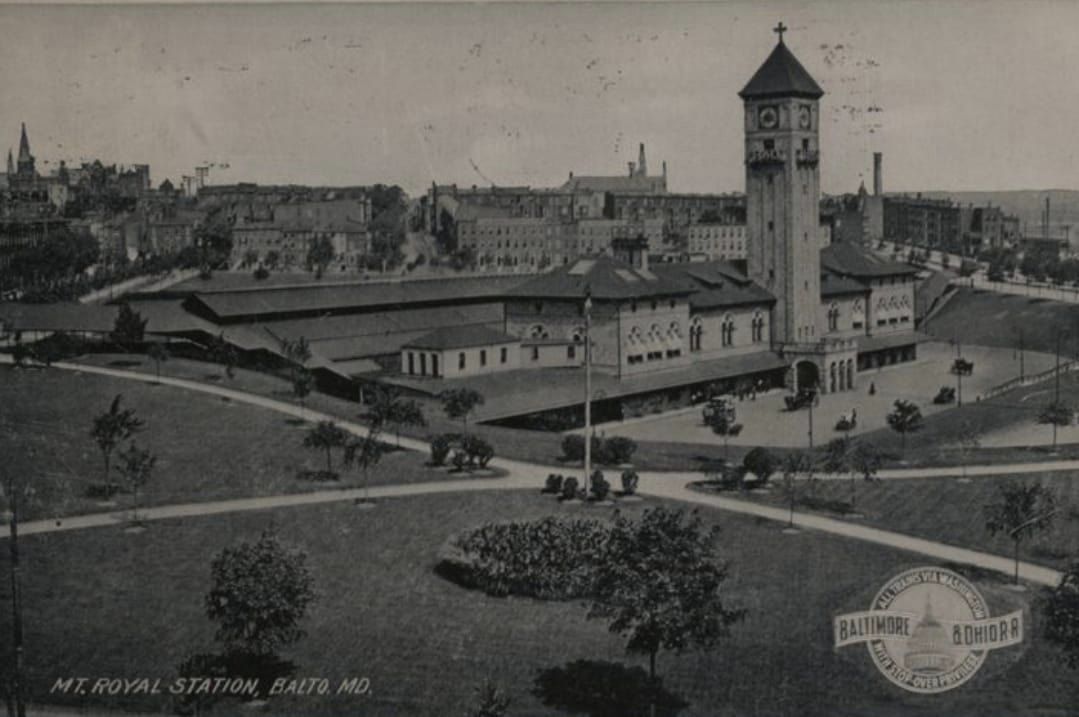 |
| Remember When: Maryland and Virginia posted Mt Royal Station • Baltimore MD • Circa 1910! Darren Reynolds shared |
A view of the North Portal from the train shed.
 |
| Photo from HAER MD,4-BALT,130--1 from md0909 1. VIEW OF NORTH PORTAL LOOKING OUT FROM UNDER MT. ROYAL STATION TRAIN SHED. - Baltimore & Ohio Railroad, Howard Street Tunnel, 1300 Mount Royal Avenue, Baltimore, Independent City, MD |
And a view of the shed and station from inside the tunnel.
 |
| HAER MD,4-BALT,130--2 2. View of Mt. Royal train shed looking out from under Howard Street Tunnel. - Baltimore & Ohio Railroad, Baltimore Belt Line, Howard Street Tunnel, Beneath Howard Street from Mount Royal Station to Camden Station, Baltimore, Baltimore (Independent City), MD |
 |
| Bill Rettberg Jr. posted Interesting view of a light Geep at the east end of the Howard street tunnel in Baltimore, getting the green over the GP 30 led westbound that will now follow. Train shed is former Mount Royal Station. Lenard London: Long hood Forward. Hoodie Doodie Doooon! Steven Ford: 6603 is the engine they used on commuter trains . I rode on it at Mount Clare on a Saturday as they would use it for other purposes on weekends . |
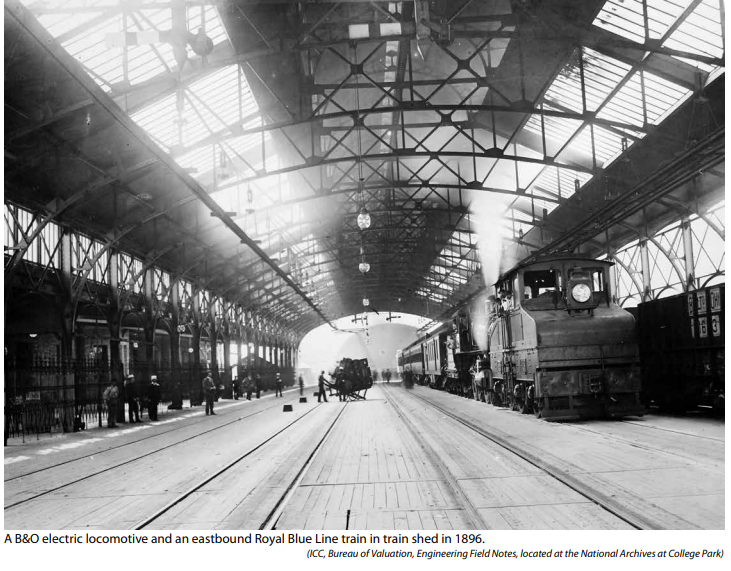 |
| borhs, p4 The trainshed is 800' (244m) x 71' (21.6m). [I'm trying to remember if I have ever used the verb "is" instead of "was" when talking about a train shed. I think this is the only extant train shed that I know about.] This was the last major passenger station built by the B&O. "The opening of the Howard Street tunnel and Mount Royal Station did, in fact, speed up the Royal Blue Line service from Washington to New York to match the Pennsylvania Railroad’s running times" |
There are five historical markers in the station explaining the preservation history. [hmdb]
They dug a hole for the shed, station and parking lot so that the station would be at track level, which, because of the tunnels, is below street level.
 |
| 3D Satellite |
A contemporary view of the train shed.
 |
| safe_image for Howard Street Tunnel Expansion Project Launches via Dennis DeBruler $466m for Howard Tunnel reconstruction and 21 other locations between Baltimore and Philadelphia |
 |
| Ghost Rails and Forgotten Highways posted In 1964 an art college bought Baltimore's Mount Royal Station, four acres and the air rights over the tracks for $250,000. Mount Royal Station opened on September 1, 1896, at the north end of the Baltimore & Ohio's Belt Line. Baldwin & Pennington designed it in granite with limestone trim under a clock tower the state's historic record puts at 143 feet. The building sits entirely inside the open cut between the Howard Street Tunnel and the Mount Royal Tunnel, so passengers went down to the trains instead of out to them. Behind it stood a steel train shed, originally 71 by 420 feet, carried on trusses with arched lower chords - one of the last gable-roof sheds built in America. The tunnel it fronted had already made history. On June 27, 1895 the B&O ran the first main-line electric locomotive through Howard Street. The Royal Blue made its last run on April 26, 1958, when the B&O ended passenger service north of Baltimore. Mount Royal hung on three more years and closed in 1961, after 65 years of operation. Trains kept moving through the cut below, but nothing stopped at the platform. Windows went out. The Chesapeake & Ohio, which had taken control of the B&O in 1963, wanted the site developed commercially, and in that era commercial development of a dead downtown station usually ended with a wrecking ball. A few blocks north, the Maryland Institute College of Art was out of room. Its president, Eugene "Bud" Leake, had already been sending overflow painting classes into the empty waiting room. The agreement closed in 1964. For $250,000 the college got the station, nearly four acres of ground, and the air rights over the tracks - the railroad kept the railroad and sold the space above it. The Baltimore Sun and MICA's own marker at the building both give that figure, and the marker calls it well below market value, effectively a donation by the B&O. The marker names the people who moved it: B&O president Jervis Langdon Jr., directors Milton Eisenhower and Charles Garland, and trustees Irving Blum, Walter Pinkard Sr. and Jesse Slingluff. Jane and Robert Meyerhoff co-chaired the capital campaign. The renovation was funded entirely with private money. The work ran through 1965 and 1966, with Cochran, Stephenson & Donkervoet as architects. The problem was volume. A two-story vaulted waiting room is magnificent and nearly useless to a college that needs classrooms. So they built a half floor down each side of the room and left the center open as a lobby, closing the new rooms behind large glass arched walls so the original space still read as one room. The only way up was a stair driven through what had been an exterior window. The rear passenger platform and the baggage room were enclosed and handed to the Rinehart School of Sculpture, foundry and kiln included. The marker puts the cost at $650,000 on top of the purchase, just over $20 a square foot. The exterior was left virtually alone, which is why a photograph from about 1902 and a Historic American Engineering Record photograph taken after the conversion look almost like the same picture. Everything that changed is behind the granite. The building went on the National Register on June 18, 1973 and was designated a National Historic Landmark on December 8, 1976. The shed still stands over the cut, and CSX freight still works the line beneath it on the approach to the Howard Street Tunnel, which reopened in 2025 after being lowered and notched for double-stack containers. If you have been inside Mount Royal Station - as a student, a sculptor, or a passenger before 1961 - what do you remember about that room? Ghost Rails and Forgotten Highways: The conversion had to be negotiated around a working railroad. When the anthropologist Margaret Mead lectured at the station in 1965, the B&O adjusted its schedule so that no trains ran under the building during her hour-and-a-half talk. Mead later called the finished building "perhaps the most magnificent example in the Western World of something being made into something else." Jeffrey Parnes shared |

No comments:
Post a Comment